Here is why I wrote this book.

The public debate about immigration rages on in Britain and abroad, and it alters language use. That usage denotes changing attitudes to immigrants. Academic researchers have noticed this phenomenon, but they usually review language use in relation to immigration in one country within the framework of a short period of time.
For example, the recent study ‘A hostile environment: Language, race, politics and the media’ by Maka Julios-Costa and Camila Montiel-McCann (Runnymede Trust, 2025) is only interested in Theresa May’s hostile environment, created in Britain in 2012, and ends the period of interest in 2014.
I think we would profit from a long-term perspective with international comparison, because it deepens our insight into the past and present. To provide that view, I have written my new book – Changes in Attitudes to Immigrants in Britain, 1921–2021. From Alien to Migrant (London / New York, Anthem Press 2025).
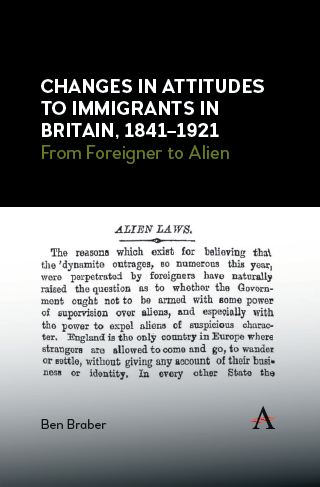
The book starts where my previous work ended – in 1921 (Changes in Attitudes to Immigrants in Britain, 1841-1921. From Foreigner to Alien, London / New York, Anthem Press, 2021).
In the new book, I examine changes in attitudes towards immigrants in Britain and the words that were used to put these feelings into words between 1921 and 2021. It deals with immigrants in Britain up to 2021 and thus embraces both the accession of Eastern European countries into the European Union and Brexit. It also covers the period beyond 2014 and the impact of Brexit and fluctuations in net migration.
It reviews in what context attitudes were articulated and where they came from. To determine what was specifically British, I make international comparisons.
Novel method
The book applies a rather novel historical and linguistic method for an analysis of so far relatively unused primary sources. It also explores secondary resources and, to provide context, engages with the existing literature that deals with immigration.
The linguistic-historical approach applied in my two studies on attitudes to immigrants in Britain shows when and how attitudes to immigrants in Britain changed after 1841, where they originated and what language was used to voice these attitudes, in particular specific words, their meanings, the under- or overtones they bore, and what people meant or felt when they used them. It highlights the way in which, over the two centuries covered, the labels attached to incomers in Britain have changed in tune with the variation of those arriving and attitudes towards them. And, finally, it links post-1921 developments to what was set in motion before 1921 to sketch a long history that runs into the present.
You can find more information about my books here.
 Ben Braber