Categories
Integration of immigrants

History of a label

The meaning and use of ‘race riot’ in British newspapers

The historian Kieran Connell (2024) has written about the ‘inability […] of the media […] to put an accurate label’ on what happened during riots in 1958 in Nottingham and Notting Hill, asserting that rather ‘than “white riots” or “racist riots”, it was “race riots” – a term more open to interpretation – that became conventional.’ This article outlines the history of that label in British newspapers.
Existing literature

This is not the first publication dealing with that subject. There is an extensive literature on riots in Britain (for example, Flett (2015), Moran (2020), Rowe (1998)). The historiography also contains many works on race riots. This article does not engage with that entire output. Instead, it highlights with selected studies to indicate the thinking about this subject.

In their pioneering study on Liverpool riots in 1919, May and Cohen (1974) have discussed the difficult nature of the ‘race riot’ concept. Holmes (1975) has done so too, reviewing race in relation to riots in Nottingham and Notting Hill in 1958, but Miles (1984) has noted that the 1958 riots were political and ideological conflicts, and that specific ideologies ensured that the idea of race came to be used to interpret them. Recently, Hilliard (2022) has re-examined the questioned relation between the Notting Hill riots and racism.

Writing about disturbances in Middlesbrough in 1961, Panayi (1991) has stated that these events can be described as race riots and fit into a pattern of previous attacks in Britain on population groups formed by immigrants and their descendants. In addition to hostility towards immigrants, Panayi has also stressed local factors that lead to the Middlesbrough disturbances as well as nation-wide youth violence, without which there would not have been a riot.

Farrar (2002) has claimed that disturbances in Leeds in 2001 were not race riots, but violent urban protests by racialised British men. However, Kanol (2010) has called other riots in northern English cities like Oldham, Burnley and Bradford in 2001 race riots. Concentrating on causes, Solomos (2011) has found that factors that shaped disturbances in 2011 included race, but he has argued against generalisations about its role, which should be viewed within a range of issues such as policing, deprivation and exclusion.

Historians in the USA have also questioned the meaning and use of the term ‘race riots’. Keenan (2016) has maintained that many US incidents of civil unrest labelled as race riots must be understood as manifestations of racial cleansing. Ray (2022) has noted that before the 1960s US race riots were popularly understood as white violence against black and other coloured.

The existing literature also contains studies of newspaper discourse on such disturbances. Following his analysis of editorials in the British press about disorders in 1985, particularly The Sun and Daily Mail, Van Dijk (1987, 1989, 1991) has concluded that in relation to racism and riots ideological structures systematically appeared in categorisation, argumentation, organisation, rhetorical devices and lexical styles of the press. Similarly, Criado (2005) has analysed how disturbances in Oldham in 2001 were reported by, among other papers, The SunDaily MailThe Independent and The Times. Both Van Dijk and Criado have emphasised the papers’ characterisation of participants in civil disorder and a tendency to label coloured people negatively as potential rioters, holding them responsible for the unrest, and differentiate a minority of troublemakers among otherwise innocent white people.

In short, the existing literature is fragmented and the concept of ‘race riots’ remains controversial. While this article cannot provide a comprehensive history of this phenomenon, it complements the existing literature by outlining the changes in the use and meaning of ‘race riot’ in British newspapers.

Sources and methodology

Within the scope of this article it is unfeasible to examine the entire newspaper output.

From the daily newspapers that appeared throughout this period and are available to this author in a digital format suitable for analysis, The Times is chosen. Published in London, it is one of Britain’s oldest and most influential papers. Although its editorial views are independent, The Times can be seen as a paper of record and epitome of the British establishment (for a history of The Times see Woods and Bishop (1983)). The paper itself is available via The Times Digital Archive in Gale Primary Sources, an online, full-text facsimile of the paper, intended to provide every page from 1785.

During the period under review, traditional newspapers like The Times evolved but also had to compete with the new popular press. In 1900 the reading public in Britain predominantly consumed local or regional newspapers, but after 1921 national popular papers, such as the Daily Mail, overtook the local and regional press (for overviews of the history of the British newspaper press, see Bingham and Conboy (2015), Griffiths (1992)). Newspapers also sought to strengthen their position in relation to other media. When broadcast news services were expanding, and the television provided respectable and entertaining content, the gaps for the press lay in supplying greater detail and in-depth investigation. Traditional papers such as The Times also adapted their editorial policies, for example creating well-illustrated and handsomely designed space for subjects that were thought to interest the public. Journalists also altered their writing styles to describe events in clear and direct but imaginary and meaningful terms (an example of a writing manual for journalists is Evans (1972)). The style change and the constant race against deadlines altered their language use, popularising certain words or phrases and their meanings, and using them as labels to denote a subject (the language use in newspapers has been discussed by Bell (1991), Fairclough (1995), Kibble (2002)). 

This article compares The Times to titles in the British Newspaper Archive (BNA). In 2025, this resource contained pages from over 1,700 newspapers published in the UK from the 18th century to the present day. The BNA is continuously growing. At first, it incorporated publications from before 1900 and cities such as Birmingham, Manchester and Leeds, along with local titles from London boroughs and smaller places. Then, it started adding material from a wider variety of papers from 1900 onwards, for example the Daily Express and Daily Mirror. As a result, newspapers aimed at local and regional audiences and popular papers feature prominently in the BNA.

The two digital collections have been searched online. Unfortunately, at present the technology available to this author still causes imprecision and the statistics reproduced in the quantitative analysis of this article contain errors and remain incomplete. Therefore, the purpose of that analysis is not providing exact and comprehensive numbers but revealing trends in word use. The qualitative analysis then applies critical methods to examine specific articles in The Times and what appeared in other newspapers. This enables the synthesis of information in a chronologically ordered narrative.

Meanings and undertones

Online lexicons provide various meanings of ‘race riot’. The Historical Thesaurus of English records its use from 1880. The Online Etymology Dictionary and the Oxford English Dictionary also list this first use in Britain, coming from American English, and describe it as a riot resulting from racial hostility or tension. The Cambridge Dictionary gives two meanings: a violent fight between people of different races; and a situation in which people from a particular ethnic group protest violently about something.

The term ‘race riot’ has connotations. ‘Race’ has various meanings, including originally the sense of shared kin, family, descent, occupation or nationality, but from the 19th century increasingly and eventually predominantly the sense of shared physical characteristics, such as skin colour. On the issue of skin colour, the Online Etymology Dictionary points out that in mid-20th century US publications ‘race’ meant ‘negro’. The Merriam-Webster Dictionary states that the use of ‘race’ referring to physical traits was for many years applied in scientific fields such as physical anthropology, with race differentiation being based on such qualities as skin colour, but advances in the field of genetics in the late twentieth century found no biological basis for races in this sense of the word. For this reason, according to the dictionary, the concept of distinct human races has little scientific standing today, apart from a sociological designation, identifying a group sharing some outward physical characteristics and commonalities of culture and history. 

The affective meaning of ‘riot’, in the sense of civil disorder or disturbance, is historically negative. The Historical Thesaurus records it under ‘Moral evil: Profligacy, dissoluteness or debauchery’. Modern lexicons emphasise the violent nature of riots.       

Quantitative analysis
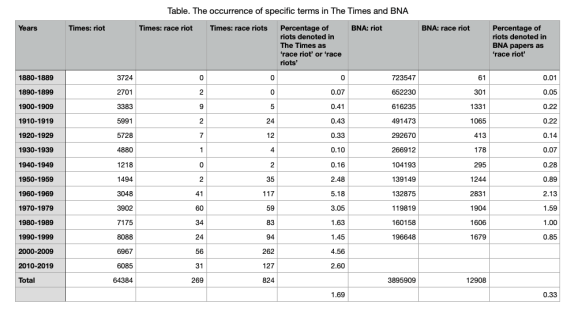
Sources: The Times Digital Archive and BNA (accessed in 2022). Percentages have been rounded up. Alternatives for the term race riot are racial riot or disturbance, ethnic riot or disturbance, and racial or ethnic disorder. A search in The Times Digital Archive shows 37 results for ‘racial riot’ from 1890, 19 for ‘racial disturbance’ from 1907, 3 for ‘ethnic riot’ from 1987, 0 for ‘ ethnic disturbance’, 13 for ‘racial disorder’ from 1961 and 0 for ‘ethnic disorder’ – although not insignificant, these alternatives have been omitted from the table. The BNA search results are unreliable after 2000.

This table shows that in the period 1880-2019 The Times used ‘riot’ 64,384 times. Although it often appeared in clusters, for example more than once per report or in more articles on one day, the word was used on average 463 times a year. It was therefore a subject that readers of this newspaper frequently saw if they read the entire paper every day. This does not mean a riot occurred in Britain every day, The Times also reported on riots abroad or discussed in parliament. In comparison, the BNA papers used ‘riot’ 3,939,056 times between 1880 and 1999, indicating that readers of a BNA paper were also frequently confronted by an article on riots.

Only small percentages of these ‘riot’ articles were on ‘race riots’. A search in The Times Digital Archive shows 269 results for ‘race riot’ from 1890, a separate search for ‘race riots’ brings up 824 results from 1900. Apparently, after initially favouring the single form, editors, journalists and letter writers in The Times as well as foreign correspondents and agency reporters were more likely to apply the plural form of this term after 1910, apart from the decade 1970-1979. A similarly separated search is impossible in the BNA, as ‘race riot’ is there also included in finds for ‘race riots’, while the BNA search for ‘race riot’ also includes false finds, for example ‘racing riot’ or ‘race. Riot’. Under this proviso, the percentages of articles using ‘riot’ that were on ‘race riots’, have been reproduced in the image below.
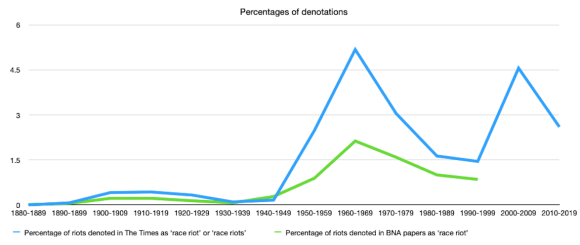
This image shows that before 1949 the percentage of ‘riots’ denoted in The Times as ‘race riot’ or ‘race riots’ remained under one percent, with the peak in 1910-1919, corresponding with the peak of ‘riot’ in 1910-1919. After 1949 the percentage in The Times rose sharply to well above one percent, peaking in 1960-1969. The percentage of ‘riots’ denoted in BNA papers as ‘race riot’ stayed under one percent until 1960, with the peak in 1950-1959. From 1949 the BNA percentage rose to 1960-1969, after that it dropped but remained well above the pre-1950 figures. The image also illustrates that after 1890, except for the decade from 1940 to 1949, The Times published relatively more articles on ‘race riots’ than BNA papers.

In short, ‘riot’ appeared on average daily in The Times and frequently in BNA papers. Only small percentages of these articles were about ‘race riots’, with higher proportions in The Times than BNA papers. Peaks in the usage of ‘race riot’ occurred during the decades 1910-1919, 1950-1959 and 1960-1969.

Qualitative analysis

On 19 December 1888 the term ‘race riot’ first appeared in a BNA newspaper. That day the Orkney Herald, and Weekly Advertiser and Gazette for the Orkney & Zetland Islands reported ‘Race riots in Mississippi’. Probably using a newsfeed from New York, the paper mentioned a ‘conflict’ between white people and ‘negroes’ in Wahalak. Reports on the incident were confusing, also with US papers such as Detroit Free Press and Knoxville Daily Tribune describing it as a ‘war’. Claims were made that whites had sought revenge after a car accident involving a white and a black driver. There was also uncertainty about the number of fatalities, varying from 2 to 12 whites and up to 150 blacks. The next use of ‘race riot’ in a BNA paper occurred on 6 February 1890, when the Ayr Advertiser reported: ‘A serious race riot has (says a New York telegram) occurred at Morgan, Georgia.’ The disturbance involved, according to the Advertiser, 7,000 persons, ‘most of them negroes […]’ It followed the lynching of a 15-year-old black boy, who was accused of murdering a 9-year-old white girl.

On 20 October 1890 The Times first used ‘race riot’, writing about violence against Italian immigrants in New Orleans. The paper reported that the US city appeared ‘to be on the eve of a sanguinary race riot’ after it had been ‘ascer­tained’ that following their murder of the chief of police, the ‘“Mafia” secret society planned to murder a number of other officials.’ Nineteen Italians were arrested, 11 of them were lynched after a mob stormed the prison. The Times wrote: ‘The public feeling is very strong against the Italian community. [A] steamer with [1,000 Italian immigrants] is now coming up the river. Some persons advocate resistance to [their] landing.’

On 3 January 1891 ‘race riot’ appeared again in The Times, but now the paper discussed the ‘negro question’ in the USA. This was followed on 6 August 1907 with a report on a New York ‘race riot’:

between whites and negroes, in which more than a thousand persons were engaged. Two white men were taken to hospital mortally injured. The trouble began with a dispute between a white and a negro over the payment of a wager. The whites used baseball bats as weapons, and the negroes used razors, while negro women climbed on the roofs of the houses and pulled bricks from the chimneys, which they threw upon the white men in the street.

The Times later reported regularly on ‘race riots’ in the US, for example on 2, 3 and 4 June 1921 in Tulsa, where during a ‘Day and Night of Terror’ about 100 people were killed, ‘mostly negroes, and in addition it is feared that as many more negroes are lying beneath the smouldering ruins of their houses.’ The 1921 Tulsa events were widely reported in Britain, for example by the Dundee Evening Telegraph (1 June), Daily HeraldDaily News and Scotsman (all 2 June) and Sheffield Daily Telegraph (4 June).

Later, The Times reported more US ‘race riots’, for instance on 9 February 1926 and 21 March 1927. However, the paper did not apply the label ‘race riot’ to disturbances in Britain until 27 August 1958, when it wrote about ‘the recent race riot in Nottingham’. This means that the 1910-1919 peak in the percentage of unrest reported in The Times as ‘race riots’ was related to reports about riots abroad, not Britain.

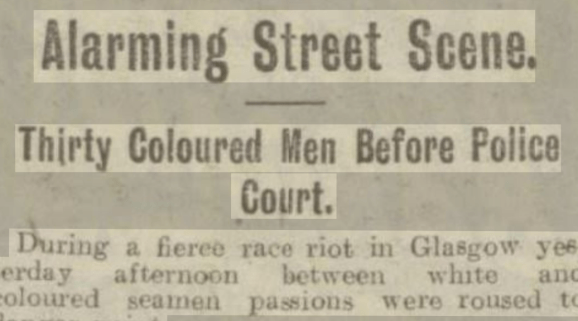
In contrast, BNA papers had from 1919 used the label to denote disturbances in Britain. One of the first outbreaks during that year was reported on 24 January in the Dundee Evening Telegraph as a ‘Fierce Race Riot’ in Glasgow. The violence broke out over competition for work, as it was thought that black sailors were given preference in signing on for a ship about to sail. This caused resentment among white sailors, who also believed that the black men accepted lower wages. It resulted in a scuffle, during which a black sailor was reported to have fired a revolver, injuring a white man in the neck, and a ‘white’ contingent charged the black men. According to the report, the white mob was armed, some with guns. Bottles and stones were thrown at the retreating black sailors and the windows of their lodging house.

More violence from white crowds was directed at black and coloured workers in 1919, leading to deaths, injuries and vandalised property in South Shields, Salford, London, Hull, Newport, Barry, Liverpool and Cardiff (overviews of these events have been provided by Evans (1980), Jenkinson (2009)).

The Daily News reported on 6 June a ‘Race Riot’ in Liverpool. The paper related how prior to this outbreak ‘racial feeling’ had been running ‘high [in the city] for some time past.’ That had resulted in a ‘fatal battle’ between Liverpool’s black population and ‘Russians and Swedes’. Whites were ‘chasing negroes’. A black man was ‘thrown into a dock and drowned’. Fourteen others were wounded. 

On 8 June 1919 the Sunday Pictorial reported ‘fierce racial riots’ in Newport. It was said that the outbreak had been stoked by relationships between black men and ‘white girls’. The violence spread down the Welsh coast to Cardiff, with houses being torched and three persons killed. It reportedly started when a black man began firing on the police which infuriated a white crowd, who attacked black and coloured men and hunted them for hours. More shooting was heard in the Welsh city, with volleys being fired in the streets and from houses.

The 1919 Welsh disturbances got national exposure in papers like Derby Daily Telegraph (12 June), Belfast Telegraph (13 June), Aberdeen Press and Journal and Dundee Courier (both 13 June) and The Times (13 and 14 June). On 13 June a correspondent of the Morning Post compared the unrest in Glasgow, Liverpool and Cardiff to colonial immigration problems in Australia and Canada and drew a parallel to lynching in the USA: ‘[…] the burning of three negroes at the stake in the United States, a horror which was witnessed by hundreds of approving men and women.’ The journalist stated ‘the coloured races and our white race cannot live together on terms of equal freedom […] It is the insuperable differ­ence that has to be recognised.’

The 1919 disturbances in Wales echoed unrest in 1911 when, in the wake of an unsuccessful miners’ strike, a wave of violence swept through the western valleys of South Wales. Property – mostly owned by Jewish shopkeepers, pawnbrokers and landlords – was attacked. Although non-Jewish tradesmen were also assaulted and The Times wrote on 24 August 1911 that a ‘spirit of indiscipline ran riot’ with ‘bottle-flinging experts’ battering ‘an alien colony’, there was little doubt about the riots being mostly aimed at Jews. Among the ‘rioters’ were reportedly fun-seeking hooligans as well as respectable working people, such as colliers and their wives, who may have feared having to pay debts to traders who had advanced credit. Five years later Wales witnessed further disturbances. On a Sunday afternoon in 1916 ‘Arabs’ and ‘negroes’ were targeted in Tiger Bay after ‘a young girl, daughter of respectable parents, was found in a dazed condition in a doorway, after having been missing for a week.’ The wider background to the incident was revealed with the suggestion in the Daily Mail on 6 October that the victims were to blame for showing off their social and economic successes: ‘[The] coloured population of Cardiff profited by high wages, almost daily take country rides in motorcars and carriages, and foreign boarding-house keepers are buying houses in suburbs.’ 

While no such ‘riots’ in Britain were reported during the interwar period, the issue returned after 1945 with the growing arrival of black and coloured immigrants, for instance from the West Indies.

In 1956 Godfrey Elton, former Under-Secretary of State for Dominion Affairs, spoke in the House of Lords (Hansard, 20 November 1956) about the settlement of West Indians, which caused ‘a problem’ that if not dealt with, would cause more ‘race riots’. He referred to the 1919 disturbances in Liverpool and said that a ‘race riot’ had taken place there as recent as 1949. Elton probably meant 1948, when the Liverpool Echo wrote on 2 and 26 August 1948 about three nights of disturbances, involving ‘white and coloured men’, which resulted in dozens of arrests and ‘six coloured men and one white man’ appearing in the magistrate’s court, after the police dispersed a crowd in the ‘coloured quar­ter’ of Liverpool and had been ‘showered with bricks […] from windows […]’. The incident was also reported in the Nottingham Journal(3 August), Aberdeen Press and Journal (4 August) and Nottingham Evening Post (10 August). During the same year, according to local papers such as the South London Observer (22 July and 5 August), disturbances took place in London, where hundreds of white men attempted to force their way into a Deptford lodging house where around 40 black immigrant workers resided, possibly after a street-fight. The police intervened and following two nights of clashes, a third drew a crowd of 1500 but passed peacefully. In several other labour hostels, including the Causeway Green hostel in Birmingham (Birmingham Gazette,10 August), tensions between black and white workers exploded.

Ten years after the Liverpool ‘race riot’ of 1948 disturbances struck Nottingham. The violence was ignited in a pub in the St Ann’s district of the city. Early reports in local papers, such as the Nottingham Evening Post (and Nottingham Evening News, both 25 August 1958), claimed the riot was initiated by black men: ‘The fight started after a young married woman, 21-year-old blonde Mrs. Mary Lowndes […] had been punched in the back by a coloured man. It happened just after closing time.’ The woman told the Post

I was leaving the St. Ann’s Well Inn with my husband […] when one of the black men hit me in the back […] The next thing I knew was that my husband was being punched from one side of the road to the other by three coloured men. I heard bottles being smashed. Everyone was screaming and shouting. 

The husband, a 23-year-old miner, came away, according to his wife, with only slight bruises to the face: ‘He knew how to take care of himself, otherwise the blacks might have killed him.’

Another white man needed 37 stitches after he was slashed ‘from ear to ear’ with a razor by a ‘coloured man’ outside the pub. A local woman who had taken a stabbed white man into her house said: ‘Coloured men were running all over the place, howling and brandishing knives. They were chasing everyone.’ The reports contained more stories of ‘darkies’ and a ‘negro’ attacking white people. A week later, trouble brewed again in St Ann’s. However, that weekend there were few black people on the street and the white mob turned on itself. The next week homes of black people were attacked, bricks and bottles were thrown, and a mob chased black men, assaulting five. The police stopped the violence.

The Nottingham Evening Post reported the first disturbance as a ‘racial clash’ and ‘racial battle’. The Nottingham Evening News spoke of ‘racial warfare’. The Times on 1 September called it a ‘race clash’, the weekly magazine Time and Tide of 6 September said ‘so-called race riots’ and the Daily Mirror had on 25 August declared a ‘race riot’.

Perhaps the fight in the St Ann’s Well Inn that reportedly started the disturbance was not caused by racial hostility but constituted a dispute between drunken people or a row between disgruntled neighbours – an ordinary pub brawl that turned into a riot. However, the Nottingham Evening Post in its reports of 25 August quoted St Ann’s residents who said a feeling of resentment between whites and blacks had been sim­mering for weeks and the ‘war boiled over when a group of Teddy Boys beat up a few coloured men.’ A local butcher also blamed Teddy Boys: ‘In a pub last week I saw one darkie being needled by a group of whites so much that he got fed up with it. When he said something to them they took him outside to report him to a policeman for starting a fight.’ The Assistant Chief Constable of Nottingham told a press con­ference that the fighting had flared up as ‘coloured people’ reprised previous incidents when ‘some of their number’ had been attacked by white men. In contrast, according to The Times (26 August, 1 and 2 September), Captain Athelstan Popkess, long-serving Chief Constable of the Nottingham City Police, said: 

This was not a racial riot. The coloured people behaved in an exemplary way by keeping out of the way. Indeed they were an example to some of the rougher elements. The people primarily concerned were irresponsible Teddy Boys and persons who had had a lot to drink.

As the first Nottingham crowd was dispersed, disturbances broke out in London when a group of young men toured Notting Hill and Shepherd’s Bush. According to The Times of 26 August 1958, they allegedly assaulted ‘coloured men’. The next weekend, violence in the capital started when about 100 white youths armed with sticks, iron bars and knives gathered near an underground station in North Kensington, apparently after rumours that a Jamaican man had assaulted his white wife. The youths threw bricks at police cars, and a man was slashed across the throat. Subsequently, wrote The Times on 1 September, fights between ‘whites’ and ‘coloured’ people erupted.

The Daily News of 2 September 1958 provided details. It mentioned Seymour Manning, a Jamaican who lived in Birmingham and was in London to visit relatives. While walking down Bramley Road he stopped to ask for directions. Three young men sprang out of a small van and attacked him. Pursued by a crowd of men and women, Manning ran into a greengrocer’s shop. ‘They are going to kill me,’ he cried. The grocer’s daughter bolted the door. She ‘thought the crowd were going to break in and get him out.’ The mob threw bottles at the shop and windows were smashed. 
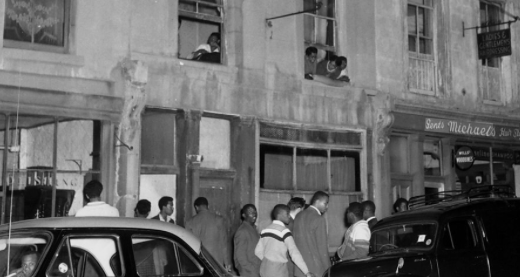
Reports in the Daily News (2 September), The Times (2, 3, 4 and 5 September) and Daily Telegraph (3 September) showed how the violence spread throughout London. In Ladbroke Grove, another black man was assaulted, being ‘kicked in the back as he left the Underground’. In Barr Road, a group of men smashed ‘a basement window with an iron-bar’ and threw a lit paraffin lamp into the room. In Uxbridge Road ‘a gang of Teddy boys beat-up a coloured man and his German girlfriend.’ Meanwhile, in Harrow Road, coloured people stood on the roof of a café, owned by a black man, ‘showering milk-bottles down on white passers-by’. As the police intervened – there were ‘threatening crowds’ – they were ‘jeered by white and coloured youths, and broken bottles were thrown.’ This led to dozens of arrests of young and middle-aged men, including blacks. Later that night the police skirmished again with white youths.

What exactly caused the Nottingham and London disorders remains unclear. Although the contemporary evidence is impressionistic, it suggests that the troublemakers were not solely Teddy Boys or young hooligans. On 8 December 1958 The Times quoted a speaker at a conference of the Consultative Committee for the Welfare of Coloured People in Nottingham: ‘1958 saw a distinct hardening in the attitude of the British people to the coloured communities among them.’ The press was to bear some responsibility for this deterioration: 

If what happened [in Nottingham and London] had involved the Irish it would have been termed ‘drunken brawl’. If it had involved sailors or Teddy boys it would have been another Saturday night scrap. Because it involved coloured people the only term the Press could use was ‘race riot’. 

If what happened [in Nottingham and London] had involved the Irish it would have been termed ‘drunken brawl’. If it had involved sailors or Teddy boys it would have been another Saturday night scrap. Because it involved coloured people the only term the Press could use was ‘race riot’.

West Indians formed not the only immigrant group who were attacked during what were reported in 1961 as ‘race riots’ in Daily Mail (21 and 22 August), The Times (21 August) and Evening Gazette (19 August). In that year disorder broke out in Middlesborough after a ‘local lad’ had been fatally stabbed by an ‘Arab’. The next day, wrote the Yorkshire Post of 21 August, a crowd threw stones and bottles at the Taj Mahal cafe, owned by an English woman and her Pakistani husband. The rioters then set fire to a table in the cafe, assaulted adjoining properties, attacked a general dealer’s shop owned by an ‘Arab’ and turned upon the police. Violence in several parts of Middlesborough lasted for days, mostly aimed at Pakistanis. Panayi (1991) has shown that local factors, such as personal hostility between the café-owners and a criminal, played a role in the disturbance. As in Nottingham in 1958, the Middlesborough Chief Constable of did not regard the disturbance ‘a major race riot’ and one of his Detective Inspectors asserted in the Daily Mail of 22 August: ‘We are satisfied that there was no actual black versus white racial conflict as such.’

Similar disturbances in Leeds in 1969 with whites attacking Pakistanis were reported in The Times of 29 July. In ‘the immigrant quarter’, following the fatal stabbing of a local teenager during the weekend, the police made 23 arrests after 1,000 people had taken part in a disturbance. On a second night of violence an ‘angry mob of several hundred people massed outside a Pakistani-owned café […] screaming and chanting: “Wogs out” […] As a bottle was hurled through the plate glass window of an Asian café, people cheered.’ Apparently, the crowd was ‘incensed’ by news that early on that day a 71-year-old woman had been attacked at her home nearby, which the police said bore ‘no connection’ to the weekend stabbing. A South-Asian man had been charged with murdering the teenager, and two other South-Asian ‘labourers’ were accused of aiding and abetting murder and possessing an offensive weapon.

So far, the UK disturbances between 1919 and 1969, which were reported as ‘race riots’ in British newspapers, involved mainly white attacking black and coloured people and colliding with the police, with blacks defending themselves or striking back. After 1969 ‘race riot’ acquired another meaning. In 1980 it was first used to label a British disturbance, when The Times reported on 3 April: ‘Police battled with hundreds of black youths in Bristol yesterday in a riot that started after a raid on a club.’ Hundreds of policemen went into the St Paul’s district of that city ‘shortly before midnight to re-establish law and order after eight hours of rioting by about 300 black youths.’ The West Indians had overturned police cars, burnt a bank and a post office, pelted firemen with bricks and bottles, and looted shops after police officers had raided the Black and White Club, allegedly a den for illegal drinking and drugs misuse. A black men told The Times it was ‘the start of a war between the police and the black community.’ Community-relations officials said that the eruption of violence probably resulted from friction which had been evident for several years.

A minister, who was driving in the area at the time, said: ‘It was not a race riot […] Colour has nothing to do with this. I think it was a question of authority, and reaction to authority rather than a question of colour.’ Politicians took a similar view. Following a statement by Home Secretary William Whitelaw in the Commons (Hansard, 3 April 1980), William Waldegrave MP emphasised ‘that the disturbances were not a race riot in the simplistic sense of those words. It was not a matter of one community attacking another.’ Tony Benn MP said: ‘Clearly it was not a race riot […]’ The Home Secretary agreed, declaring: ‘[…] it was not in any sense a race riot.’ The Secretary’s statement was reported in The Times on 3 and 5 April 1980 as: ‘[…] not a race riot in the sense that black people were attacking white people.’ And: ‘It is not in a simplistic sense of the word a race riot. It is not a matter of one community fighting another.’ BNA papers reported such opinions. The Bristol Evening Post of 3 April 1980 quoted a community worker who said it was not a ‘race riot’: ‘It was a riot of depression. It is this depression that exploded.’ Similarly, on 3 April 1980 the Daily Express described the ‘ugly scene’ as ‘not so much a race riot [but] a spontaneous eruption of violence on the part of the black community.’

An editorial in The Times of 7 April 1980 qualified these denials and thus introduced a new interpretation of ‘race riot’:

Some have taken consolation in the opinion that what happened in Bristol was not a race riot. That needs qualification […] the affair was racial in as much as it is traceable to a concentration of people of West Indian origin in that place, to the social fabric of their surroundings, and to the disproportionately poor prospects they have cause to expect for themselves, especially the young among them. A significant proportion of black youth there and elsewhere are estranged from a society which bears hardly upon them; and they have, in the colour of their skins, the strongest of all promptings to feel self-consciously racial about it.

British newspapers now attributed a new, additional meaning to ‘race riot’. The Liverpool Echo on 3 April 1980 indicated the origins of the additional meaning when it reported under the title ‘Angry ghetto’: ‘The Bristol flare-up has not come as a surprise to immigrant leaders and social workers in the area. For years they have been predicting that the festering tension in the deprived slums would explode.’

The word ‘ghetto’ in the Liverpool paper referred to areas in US inner cities where American blacks were concentrated. During the 1960s and 1970s large disturbances broke out in these ghettos. This coincided with increasing usage of ‘race riot’ in British newspapers. As shown in the quantitative analysis, peaks in the percentage of reports of ‘riots’ denoted as ‘race riots’ appeared in 1960-1969 in The Times and BNA papers.

The disturbances in the USA were different from earlier unrest. For instance, unrest in 1967 in Detroit, Michigan, was one of more than 150 disorders across the country in the summer of that year, in which black people vented their anger about what they regarded as inequality and oppression. The direct cause in Detroit was a police raid on an illegal black pub. Less than a year later, the murder of Martin Luther King led to a US-wide wave of similar disturbances. The unrest did not subside. In 1969, for example, The Times on 28 June reported a ‘race riot’ in an industrial town north of Indianapolis, which was said to have begun after a group of whites burnt a cross and Black Panthers injured policemen with shotguns.

The US events were widely reported in Britain. A search for ‘race riot’ in the BNA finds 548 articles in 1967. A similar search in The Times shows six results for the same. The article of 21 July in The Times, ‘Race Riot Danger in Britain’, quoted a ‘warning of race riots in Britain tomorrow’ in a British government-supported report that said: ‘If England is not to be the scene of race riots the time for action is now, tomorrow may be too late.’

The Bristol disorder of 1980 thus resembles the US disturbances of the 1960s and 1970s. It may even have been influenced by the news about the US events. As a result, ‘race riot’ now meant either an incident where one population group attacked another, mostly white against black and coloured people, including immigrants and their descendants, or disorder from people with black and coloured skins.

The Bristol disturbance was repeated later – often at a much larger scale – in other English cities and towns, for instance in 1981, 1985 and 2011. In April 1981, following police intervention in a stabbing of a black boy, police officers were attacked in Brixton, London, possibly as it was believed the police had stopped and questioned the stabbed boy, rather than help him. Hundreds of black youths turned on the police and the disturbance lasted for days, with people injured, vehicles destroyed and shop premises burned, damaged and looted. Disturbances also took place elsewhere in the capital. The Times did not report this as a ‘race riot’ and several BNA papers stated opinions that this disturbance was not such an event; the Sunday Mirror of 19 April 1981 called it ‘an antipolice riot’. However, the Daily Express of 13 April 1981 was adamant: ‘The urgent lessons of Brixton […] WHEN the American race riots appeared on British television screens in the 1970s, we thought they could never happen here. Now they have – with a vengeance.’ 
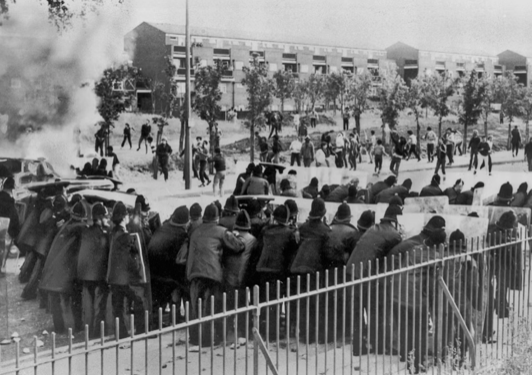
A few months later, similar events occurred in Toxteth, Liverpool, where after a perceived heavy-handed arrest of a black man, police were attacked by blacks with petrol bombs and paving stones. The unrest also affected other Merseyside districts, Birmingham, Leeds, Manchester, Bradford, Halifax, Blackburn, Preston, Wolverhampton, Newcastle, Nottingham, Derby, Leicester, Southampton and Portsmouth. The Times on 6 July 1981 reported the event in Toxteth ‘was not a race riot in the context of Brixton […]’, mostly as white and black youths fought the police together. Some BNA papers concurred, but others, including the Daily Express on 4 and 6 July, spoke of ‘race riots’.

In 1985, the ‘Broadwater Farm riot’ in London was related to the death of an immigrant woman and it followed a week after another black woman had been shot by the police. Some newspapers blamed the black population for the riot. On 30 September 1985, The Sun claimed ‘The blacks must act’ and on 8 October 1985 the Daily Mail‘s editorial was titled ‘The choice for Britain’s blacks’. In 2011, violence broke out in London after a black man was shot fatally dead by police in Tottenham. Subsequently, disorder took place in cities and towns across England, including Birmingham, Bristol, Coventry, Liverpool, Manchester, Nottingham, Derby and Leicester. 

Other immigrant groups and their descendants also got involved in such disturbances, for example in 2001 in Leeds, where hundreds of young men of South-Asian descent clashed with the police after the allegedly wrongful arrest of a South-Asian man. In the Harehills area of the city the youths erected a barricade of burning washing machines and furniture, looted from a second-hand shop. Cars were burnt, a shop was set alight, police officers, journalists and onlookers were injured. During the same year, a disorder ensued when South Asians in Bradford confronted extremist right-wing groups, culminating in the stabbing of a South-Asian man and a South-Asian man firebombing the Manningham Labour Club. Meanwhile in Oldham, hundreds of South-Asian youths used petrol bombs, attacked a pub and the offices of a local newspaper and battled the police. The Times reported on 17 and 18 April 2001 that the police first said the ‘riot’ was ‘not racial’ but then admitted that ‘race did play part’ in the event.

Fighting also occurred between groups of immigrants and their descendants. On 27 May 2006 The Times wrote that three young South-Asian men were found guilty of mur­dering a young black man. The trio were said to be members of a much larger South-Asian gang that chased the man at the height of ‘riots’ in 2005 in Birmingham: ‘[…] one of the first cases to receive national attention that has portrayed racism as something other than a black and white issue.’ What exactly happened is unclear. Perhaps the unrest arose from tensions between West-Indian and South-Asian groups living in and around the Lozells area of the city, which may have been fuelled by economic rivalry and the activity of opposing gangs. The spark that ignited the violence was thought to have been an unsubstantiated rumour about a gang rape of a Jamaican teenager by a group of Pakistani men.

The newspaper reporting of ‘race riots’ continues to the present day. For example, during the protests at hotels housing asylum-seekers. In 2024, after rumours that a migrant killed three girls in Southport, anti-immigration riots spread from across Britain. The Daily Express wrote on 12 August 2024: ‘Britain’s Commonwealth future in jeopardy thanks to race riots’. On 14 June 2025 The Guardian commented on ‘race riots’ against the local ‘migrant population’, which had started in Ballymena, Northern Ireland, ‘ostensibly triggered by the arrest of two boys, reported to be of Romanian origin, accused of sexually assaulting a teenage girl.’ The white rioters drove out dozens of Romanian and Bulgarian families and ‘other foreigners’. A month later, an asylum-seeker assaulted a teenage girl and woman in Epping. The culprit was quickly arrested, found guilty and convicted, but large rallies across Britain turned violent against immigrants residing in hotels and community-based accommodation, and were labelled as ‘race riots’ on websites of various newspapers such as the Daily Mail (24 and 25 July), Daily Express (2 August) and The Times (23 August).

Conclusion

This article has outlined the history of the term ‘race riot’ in British newspapers. It has found that ‘race riot’ was an Americanism that was applied as a label in British newspapers from 1888 to various disturbances with different characteristics and dissimilar causes. However, it always had undertones, because of the negative loading of the word ‘riot’ and the association of ‘race’ with black or coloured people.

In 1888 the label ‘race riot’ was attached by British newspapers to a disturbance in the USA, in which whites attacked black people. In 1890 it referred to a US disorder, in which whites attacked white immigrants. From 1919 papers started to report disturbances in Britain as ‘race riots’. No ‘race riots’ in Britain were reported during the interwar period, but the issue returned after 1945 with the settlement of immigrants with non-white skin colours. The label was applied in 1948 to disturbances in Liverpool involving white and coloured men, in 1958 to unrest in Nottingham, possibly initiated by black men, and to disturbances in London with white attacks on black people, who sometimes fought back, and in 1961 to riots in Middlesborough where whites attacked South Asians. 

From 1980 ‘race riot’ – as used for disturbances in Britain – acquired an additional meaning. This started in reports on disturbances in Bristol, where blacks attacked white property and the police. Politicians denied it was a ‘race riot’ in the sense of one population group attacking another. The Times qualified this denial and introduced the new interpretation of ‘race riot’. So, eventually the label ‘race riot’ had two meanings: 1. members of a population group attacking members of another group, mostly whites assaulting people with non-white skin colours or different origins; and 2. disturbances by black and coloured people, destroying property and assailing the police. The acquisition of the second meaning also came from the US.

In the second meaning the extensive use of the label ‘race riot’ helped to marginalise specific population groups in Britain, particularly marking immigrants and their descendants who were perceived as a different race because of their skin colour. For example, the statement in the Morning Post in 1919 that coloured and white races cannot live together as equals because of insurmountable differ­ences. Or the interpretation in The Times of the 1980 Bristol disturbances that stressed the large number of black youths estranged from society. And the insistence of The Sun and Daily Mail that black population groups bore responsibility for the 1985 disturbances. This confirms the findings of scholars like Van Dijk and Criado who have emphasised a prejudiced tendency in newspapers to classify black and coloured people as troublemakers.

To escape this bias, avoid further confusion, acquire more knowledge and gain deeper understanding, this article suggests redefining a ‘race riot’ in neutral terms as an incident of civil disorder involving two or more population groups perceived as races because of shared outward physical characteristics or cultural commonalities and resulting from tension or hostility between these groups. 

References

Bell A (1991) The Language of News Media. Oxford: Blackwell. 

Bingham A and Conboy M (2015) Tabloid Century. The Popular Press in Britain, 1896 to the Present. Bern: Peter Lang.

Chessum L (1998) Race and Immigration in the Local Leicester Press, 1945–62. Immigrants and Minorities 17, 36–56.

Connell K (2024) Multicultural Britain. A People’s History. London: Hurst.

Criado R (2005) Oldham’s 2001 Race Riots: A Critical Discourse Analysis of British and Spanish Newspapers. In: Carrió-Pastor ML (ed.) Perspectivas Interdisciplinares de la Linguïstica Aplicada. Volumen II. Valencia, Universidad Politécnica de Valencia, 75-87.

Evans H (1972) Newsman’s English, London: William Heinemann.

Evans N (1980) The South Wales Race Riots of 1919. Llafur 3, 5–29.

Fairclough N (1995) Media Discourse. London: Bloomsbury.

Farrar M (2002) The Northern ‘race riots’ of the summer of 2001 – were they riots, were they racial? A case-study of the events in Harehills, Leeds’, paper delivered at the BSA ‘Race’ and Ethnicity Study Group Seminar ‘Parallel Lives and Polarisation’, 18 May 2002, City University, London.

Flett K (ed.) (2015), A History of Riots, Cambridge: Cambridge Scholars Publishing.

Griffiths D (ed.) (1992) The Encyclopedia of the British Press, 1422–1992. London: Macmillan.

Hilliard C (2022) Mapping the Notting Hill Riots: Racism and the Streets of Post-war Britain. History Workshop Journal93, 47–68.

Holmes C (1975) Violence and Race Relations in Britain, 1953-1968. Phylon 36, 113-124.

Kanol E (2010) An Analysis of Selected Factors Regarding the Race Riots in Britain. Available at: https://www.academia.edu/315579 (accessed September 2025).

Jenkinson J (2009) Black 1919: Riots, Racism and Resistance in Imperial Britain, Liverpool: Liverpool University Press.

Keenan, H (2016) From Tulsa to Ferguson: Redefining Race Riots and Racialized Violence, thesis City University of New York.

Kibble M (2002) ‘The Betrayers of Language’: Modernism and the Daily Mail. Literature and History 11, 62–80.

May R and Cohen R (1974) The Interaction between Race and Colonialism: A Case Study of the Liverpool Race Riots of 1919, Race and Class 16, 111–126.

Miles R (1984) The Riots of 1958: The Ideological Construction of Race Relations as a Political Issue in Britain. Dissertation University of Glasgow.

Miles R (1984) Notes on the ideological construction of ‘race relations’ as a political issue in Britain. Immigrants & Minorities 3, 252-275.

Moran, M., Riots. Available at: https://www.oxfordbibliographies.com/display/document/obo-9780190922481/obo-9780190922481-0006.xml (accessed September 2025)

Panayi P (1991) Middlesbrough 1961: A British race riot of the 1960s? Social History 16, 139-153.

Ray, V (2022) On Critical Race Theory. Why it Matters & Why You Should Care, New York: Random House Publishing Group.

Rowe M (1998) The Racialisation of Disorder in Twentieth Century Britain, London: Routledge.

Schofield C. and Jones B (2019) ‘Whatever Community Is, This Is Not It’: Notting Hill and the Reconstruction of ‘Race’ in Britain after 1958. Journal of British Studies 58 (2019), 142–173.

Solomos J (2011) Race, Rumours and Riots: Past, Present and Future. Available at: http://www.socresonline.org.uk/16/4/20.html (accessed September 2025).

Van Dijk TA (1987) Communicating Racism: Ethnic Prejudice in Thought and Talk, London: Sage.

Van Dijk TA (1989) Race, riots and the press. An analysis of editorials in the British press about the 1985 disorders. Gazette, 229-253.

Van Dijk TA (1991) Racism and the Press. London: Routledge.

Woods O and Bishop J (1983) The Story of The Times. London: Joseph.

Categories
Integration of immigrants

What integrations means

The raging public and political debate about immigration in Britain changes the use and meaning of English words related to immigrants. One of these words is ‘integration’.

The noun integration comes from the verb to integrate, defined by the online dictionary Merriam-Webster in neutral terms as: 1. to form, coordinate, or blend into a functioning or unified whole (unite); and 2. to incorporate into a larger unit or to unite with something else. So, when immigrants integrate they simply become part of a larger society.

Affective

However, ‘integration of immigrants’ now also has an affective meaning. For example, in February 2010 the Conservative Member of Parliament Philip Holobone, said during a Commons debate on Population and Immigration:

If there are a small number of immigrants arriving and spreading themselves out across the country, of course there will be integration. But if there are large numbers of immigrants arriving in a small number of places where they often do not speak English or integrate into the British way of life, there will be huge problems.

Holobone’s choice of words indicates that he feels that immigrants should integrate into British society by learning English and adopting British culture and customs. In other words, they should assimilate or conform.

The shift on what it means for migrants to integrate is not specifically British. In February 2025 the journalist Rachida Azough wrote in an essay on the ‘integrationparadox’ for the Dutch weekly De Groene Amsterdammer: ‘You [the immigrant] are never “adjusted” enough. Is it not time to bin the term integration?’

Definition

To avoid misunderstanding, in my work I define integration of immigrants as a process through which a migrant group becomes part of a society without necessarily losing the group’s original identity and characteristics, and during which the wider society itself undergoes changes by absorbing the immigrants.

Many factors can influence such a process. They include the feelings in the existing general population about newcomers. Currently racism, hate and discrimination continue to affect people from black, Asian and ethnic minority groups and others with immigrant backgrounds.

Attitudes

Quite a few attitudes in the present general population towards immigrants hark back to emotions evoked before 1921. These feelings probably became part of a collective memory and were conveyed from one generation to the next, to rise again repeatedly.

However, people can change their attitudes and behaviour. So, I hope to have produced studies that clarify history and provide insights that prove useful in studying and supporting processes of integration that take place as human migration across the globe persists.

You can find more information about my work here.

Categories
Integration of immigrants

A long-term view

Here is why I wrote this book.

Front cover of Changes in Attitudes to Immigrants in Britain, 1921-2021

The public debate about immigration rages on in Britain and abroad, and it alters language use. That usage denotes changing attitudes to immigrants. Academic researchers have noticed this phenomenon, but they usually review language use in relation to immigration in one country within the framework of a short period of time.

For example, the recent study ‘A hostile environment: Language, race, politics and the media’ by Maka Julios-Costa and Camila Montiel-McCann (Runnymede Trust, 2025) is only interested in Theresa May’s hostile environment, created in Britain in 2012, and ends the period of interest in 2014.

I think we would profit from a long-term perspective with international comparison, because it deepens our insight into the past and present. To provide that view, I have written my new book – Changes in Attitudes to Immigrants in Britain, 1921–2021. From Alien to Migrant (London / New York, Anthem Press 2025).

The book starts where my previous work ended – in 1921 (Changes in Attitudes to Immigrants in Britain, 1841-1921. From Foreigner to Alien, London / New York, Anthem Press, 2021).

In the new book, I examine changes in attitudes towards immigrants in Britain and the words that were used to put these feelings into words between 1921 and 2021. It deals with immigrants in Britain up to 2021 and thus embraces both the accession of Eastern European countries into the European Union and Brexit. It also covers the period beyond 2014 and the impact of Brexit and fluctuations in net migration.

It reviews in what context attitudes were articulated and where they came from. To determine what was specifically British, I make international comparisons.

Novel method

The book applies a rather novel historical and linguistic method for an analysis of so far relatively unused primary sources. It also explores secondary resources and, to provide context, engages with the existing literature that deals with immigration.

The linguistic-historical approach applied in my two studies on attitudes to immigrants in Britain shows when and how attitudes to immigrants in Britain changed after 1841, where they originated and what language was used to voice these attitudes, in particular specific words, their meanings, the under- or overtones they bore, and what people meant or felt when they used them. It highlights the way in which, over the two centuries covered, the labels attached to incomers in Britain have changed in tune with the variation of those arriving and attitudes towards them. And, finally, it links post-1921 developments to what was set in motion before 1921 to sketch a long history that runs into the present.

You can find more information about my books here.

Categories
Joods verzet in Nederland

Naar de Februaristaking

Joods verzet aan de vooravond van de staking

Op 11 februari 1941 brachten Joodse jongens een gevoelige nederlaag toe aan Nederlandse nazi’s tijdens een veldslag op het Amsterdamse Waterlooplein. De vechtpartij zette een reeks gebeurtenissen in gang, uitmondend in de Februaristaking, een algemeen protest tegen de Jodenvervolging dat de groei van het verzet versnelde.

Een Amsterdamse markt.

Wat was de achtergrond van die veldslag?

In 1940 hadden al incidenteel knokpartijen plaatsgevonden tussen NSB’ers en hun tegenstanders in steden als Rotterdam, Delft, Den Haag en Utrecht. In Amsterdam kozen nationaal-socialisten de markten als doelwit van hun acties. Een van hun kranten, Het Nationale Dagblad, schreef op 5 september 1940:

De markten wemelen van schreeuwende en scheldende joden die een ergernis zijn voor allen die het goed meenden met het wel en wee van de hoofdstad.

Dit naar aanleiding van onlusten op het Amstelveld drie dagen eerder. Volgens het dagblad was een niet-Joodse koopman het slachtoffer van een hetze van Joodse marktlieden die “door schelden en andere unfaire middelen trachtten […] hun arische collega’s te beconcurreren tot deze den ongelijken strijd moeten opgeven.” Een Joodse standwerker had zijn scheermesjes aangeprezen met de woorden: “En hiermee kun je Hitlers keel afsnijden.” NSB’ers vielen hem aan raakten in gevecht met omstanders. 

Willekeurig

Daarnaast molesteerden de nazi’s willekeurig mensen, omdat deze op hun stereotype van een Jood leken. Dat gebeurde bijvoorbeeld in een tram. Een getuige vertelde de politie: 

Ik zag toen ook, dat twee van de mannen een Jood te pakken hadden en hem ernstig mishandelden […] Eén van de mannen, een kort dik persoon, hing de Jood op de rug, hield hem met zijn linkerarm omstrengeld en bokste hem met zijn rechtervuist herhaaldelijk opzettelijk en krachtdadig op het gezicht, als het ware van onder uit. Terwijl hij dat deed, gaf een der andere mannen de Jood opzettelijk en herhaaldelijk hevige vuistslagen op diens gezicht. 

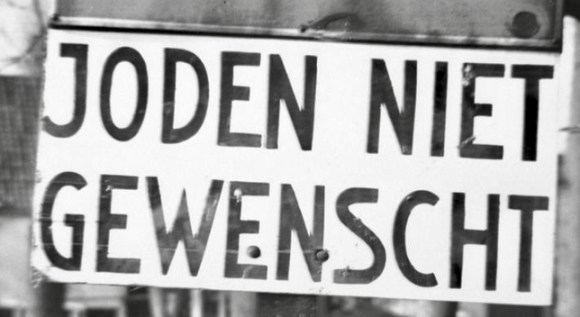
Vroeg in 1941 probeerden NSB’ers Duitse maatregelen uit te voeren die Joden de toegang verboden tot openbare gelegenheden en publieke terreinen. De nationaal-socialisten kwamen met bordjes “joden niet gewenscht”. Ze wilden die ophangen in openbare gelegenheden. Dat ging met vechtpartijen gepaard, want niet iedereen liet zich de les lezen. Als gevolg daarvan vonden op zondag 9 februari 1941 gevechten plaats op het Amsterdamse Rembrandtplein. Op die dag veroverden leden van de geüniformeerde Weerbaarheidsafdeling (WA) van de NSB  en individuele Duitse soldaten Alcazar, het laatste café op het plein dat de bordjes weigerde aan te brengen. De politie arriveerde, maar moest zich terugtrekken vanwege de aanwezigheid van Duitse militairen. 

Aangemoedigd door dit succes trokken de WA’ers even na zes uur ’s avonds naar de Joodse buurt. 

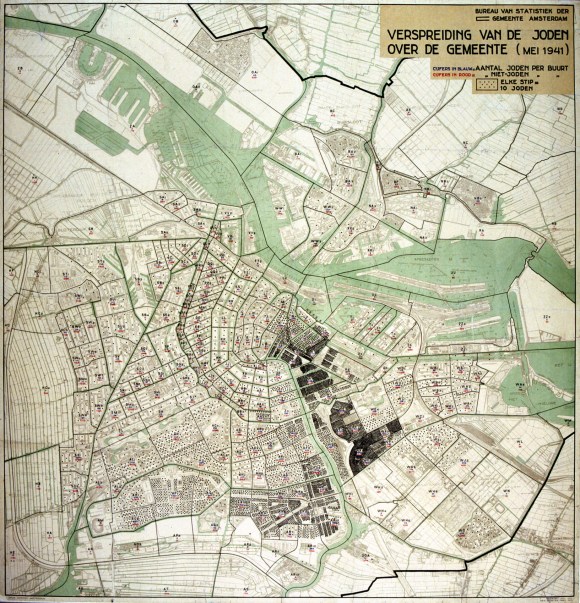
In 1941 maakte de gemeente Amsterdam, net als andere gemeenten, voor de bezetters een overzicht van Joodse woningen in de stad. Op de kaart is met stippen aangegeven hoeveel Joden er in iedere straat wonen. Eén stip staat voor tien Joden.

De WA’ers trapten deuren in, vernielden meubilair en mishandelden bewoners van enkele huizen in de Houtstraten bij het Waterlooplein. Elders sneuvelden ruiten. Een getuige:

We zaten in het café van Willem Kuipers. Met [biljartkeus] gingen we de [nationaal-socialisten] te lijf. Eén van ons had een mes. [Een ander] heeft er zelfs één van de tram geslagen.

Er waren ook vechtpartijen in de Vissteeg, Jodenbreestraat en Sint Antoniesbreestraat. Pas na het verschijnen van de Duitse militaire politie keerde de rust enigszins terug. Het kwaad was echter al geschied. 

Veerkracht

De verslagenheid in de buurt was groot. Op maandagochtend deden buurtbewoners aangifte op het politiebureau aan het Jonas Daniël Meijerplein. Ze rapporteerden mishandeling, vernieling en diefstal. Er gingen geruchten dat de nazi’s hadden geroepen dat ze terug zouden komen. Maar naast de angst ontstond er ook een stemming van “als ze nog eens komen, slaan we terug”. Een journalist noteerde in zijn dagboek: 

Rinkelend vlogen de ruiten aan scherven, kletterend vielen ze op straat en in de etalages. Dat was de eerste aanslag op de Jodenbuurt […] Maandag ontwaakte de veerkracht […] Er waren kerels op de Jodenbreestraat, geoefende worstelaars en boksers en zij durven hun man in de ogen te zien. 

Op straat zag je inderdaad groepjes mannen die het nieuws bespraken. Buurtbewoners en jongeren uit andere stadsdelen kwamen ook bij elkaar in koffiehuizen en cafés, zoals Kuipers in de Jodenbreestraat, Nikkelsberg op het Waterlooplein en ‘t Stuivertje bij de Korte Houtstraat. Een handelaar in oud ijzer sprak mannen toe in een koffiehuis: “We nemen het niet, ik stel mij borg voor het Joodse ras. Ik doe het niet voor het één of ander […] dat weten jullie wel.” Ze konden bij hem in de loods een stuk oud ijzer halen. 

Knokploegen

De mannen formeerden knokploegen die terug konden vechten als de nationaal-socialisten weer kwamen. Joël Cosman, bokstrainer van sportschool Olympia, was naar eigen zeggen benaderd door de schrijver Maurits Dekker. Of hij zijn jongens niet bij elkaar kon halen. Ze trainden in ploegen en bouwden een verhuiswagen om tot overvalwagen, zodat ze snel konden uitrukken als er in de stad wat voorviel. Ben Bril gaf de knokkers boksles. 

Op straat voerden degenen die al eens hadden geknokt of gewend waren op straat te vechten het hoogste woord.

Onder die jonge Joden was Lard Zilverberg – “een kleine driftkikker”, volgens zijn vriend Bennie Bluhm.

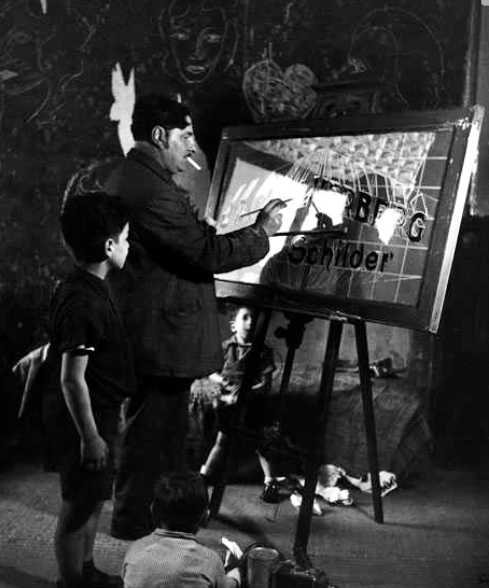
De vader van Lard Zilverberg.

Lard Zilverberg werd in 1916 in Amsterdam geboren, als oudste zoon van een reclameschilder en tekenaar. Het gezin woonde in de Valkenburgerstraat, ten noordoosten van het Waterlooplein tussen de Oude Schans en Rapenburgerstraat. Lard had een zus en vier broers. De familie had wortels in Coevorden – Lards opa was in 1889 met zijn gezin naar Amsterdam gekomen. Na de lagere school kreeg Lard werk als leerling-behanger. Later ging hij in de leer bij zijn vader. Als ze geen werk hadden, wat nogal eens voorkwam, fietsten ze met een letterkist achterop door de stad om winkeliers te vragen of die reclame op de ramen nodig hadden. 

Vlieggewicht

In zijn vrije tijd bokste Zilverberg. Hij trainde bij verschillende clubs en bracht het in 1938 tot kampioen vlieggewicht van Nederland. Hij was niet groot. Een keuring voor militaire dienst in 1935 verklaarde hem “voorgoed ongeschikt”. Toch kon je hem moeilijk over het hoofd zien. Hij was temperamentvol, kon fel spreken en goed van zich afslaan. Voor de bezetting vocht hij al met NSB’ers. Bennie Bluhm, de eerdergenoemde vriend van Lard vertelde me in 1984 hoe ze voor 1940 al een NSB’er te grazen namen:

Die vent stond in een etalage te kijken. We tikten hem op de schouder. Hij draaide zich om en we sloegen hem dwars door de winkelruit.

Ook plakte Zilverberg affiches en schilderde leuzen op muren, zoals “fascisme is moord”. In de buurt van Coevorden, waar zijn opa vandaan kwam, hielp hij vluchtelingen over de grens en bracht ze naar Amsterdam. Na de Duitse inval van mei 1940 kwamen al die ervaringen goed van pas.

Voorop

Zilverberg stond voorop in februari 1941: “Als jullie vanavond met z’n tienen komen, ga je daar staan.” Niet iedereen luisterde. De Joodse knokkers wilden zich organiseren, maar er was weinig coördinatie en veel verwarring. Als gevolg daarvan waren er honderden mannen op straat, rondlopend en voortdurend nieuwtjes en geruchten uitwisselend. 

Na nieuwe schermutselingen op maandagavond 10 februari bij het Tip Top Theater bleef het de dag erna onrustig in de buurt. ’s Middags werd er gevochten op de Oude Schans bij een winkel van een NSB’er. Drie mensen raakten gewond. Rond vijf uur deed een nationaal-socialist aangifte op het bureau Jonas Daniël Meijerplein. Toen hij weg wilde rijden, kreeg de man een ijzeren buis door de voorruit van zijn auto en daarop reed hij drie mensen aan. Een van de slachtoffers overleed. Het gerucht ging dat de nationaalsocialisten ’s avonds een synagoge in brand wilden steken, mogelijk een gebedshuis op het Jonas Daniël Meijerplein. De situatie was uiterst chaotisch. 

Even na halfzeven vertrok een groep van ongeveer veertig WA’ers van hun vendelkwartier op het Singel. Volgens een politie-inspecteur “met de bedoeling (onaangekondigd) te lopen door de Jodenbuurt”. 

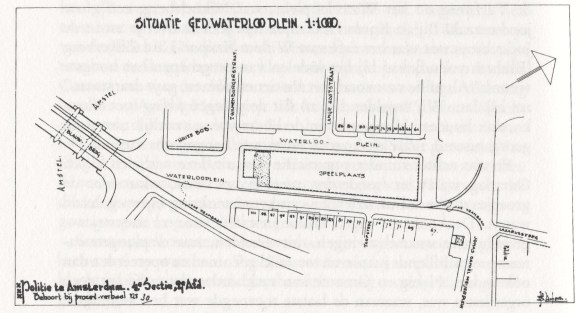
Map of the Waterloo Square
Het Waterlooplein

Via de Staalstraat marcheerde de groep over de brug van de Zwanenburgwal de Zwanenburgerstraat in, misschien zingend en daardoor nog meer de aandacht trekkend. Ze sloegen linksaf, via de oneven zijde van het Waterlooplein, waar de trambaan lag, in de richting van de Mozes en Aäronkerk en het Jonas Daniël Meijerplein. In het donker van de Turfsteeg stond Lard met andere jonge Joodse mannen. Bennie Bluhm was een van hen. Hij vertelde mij:

Het was een mistige, nattige avond. Wij lieten ze komen, want we wisten dat er verderop in de straten en stegen nog eens tachtig van onze jongens stonden. 

Eén WA’er was op de fiets gekomen. Hij ging vanuit de Zwanenburgerstraat direct linksaf, waardoor hij langs de even zijde van het Waterlooplein in de richting van de kerk fietste. Er werd iets geroepen als: “Dat is er ook één […] Grijpt hem.” Hij kreeg een stuk ijzer tegen zijn hoofd. Er werden ook stenen gegooid. Zijn WA-makkers aan de overkant van het plein hoorden het tumult en wilden hem in looppas gaan ontzetten. 

Op leven en dood

Op dat moment kwamen de Joodse knokkers tevoorschijn. Er werden messen getrokken. Men sloeg op elkaar in met gummistokken, koppelriemen, staven ijzer, knuppels en dergelijke. Ze raakten hun tegenstanders vooral op hoofd en schouders. Een vechtersbaas – bijgenaamd Jumbo – zou de nazi’s met stenen in het gezicht hebben geslagen. Het was een gevecht op leven en dood. 

Een ander zag dat de WA’er Hendrik Koot de eerste klappen kreeg onder de klok op de noordwesthoek van de speeltuin die het Waterlooplein in twee helften verdeelde: 

Ja, ik was er bij. Eerst heeft [Koot] woorden gehad met iemand, waar hij tegen schreeuwde, dat hij het jodenzootje wel even zou uitroeien. Toen schreeuwden wij terug, dat hij komen kon. Wij stonden met verschillenden opgesteld. Toen er één begon te vechten, kwamen zij allemaal. 

Ze sloegen op Koot in. Hij wankelde, richtte zich op en slaagde erin enkele meters weg te komen, maar ze grepen hem opnieuw, waarna hij bezweek. 

De veldslag was snel beslist. Haat- en wraakgevoelens ontlaadden zich binnen enkele minuten. Sommige Joodse knokkers arriveerden bijna te laat op het plein: “Toen wij erbij kwamen, waren er al een stel aan het vechten. Wij liepen het plein op en hoorden roepen: ‘Ze komen eraan.’ Je sloeg maar op uniformen, dat was altijd goed.” Anderen misten de slag. De nazi’s trokken zich terug over de Blauwbrug. 

Eerste hulp

Om kwart over zeven arriveerden de eerste gewonden op een eerstehulppost in de Jodenbreestraat. Het personeel van de post noteerde hun namen in een logboek. Koot had hoofdwonden en een schedelbasisfractuur. Hij werd overgebracht naar het Binnengasthuis. Daar overleed hij aan zijn verwondingen.

Arnold Arian op zijn trouwdag.

Vier minuten na Koots aankomst in de hulppost kwam Arnold Arian met een steekwond in het bovenlichaam. Arnold, geboren in 1908 in Amsterdam, was schilder en lid van de sportclub Olympia. Een andere Joodse knokker had een hoofdwond. De Joodse gewonden werden verbonden en naar het Nederlands Israëlitisch Ziekenhuis (NIZ) gezonden. En zo ging het nog even door. Om even na kwart over negen noteerde de hulppost de laatste gewonde: een niet-Joodse man die was neergeslagen en mishandeld. Ze stuurden hem naar het NIZ – blijkbaar rekende men hem tot de Joodse knokkers.

Afrossing

Inmiddels had de Duitse politie de buurt afgezet. De bezetters arresteerden een twintigtal Joodse jongens die op straat waren blijven hangen, onder wie Lard Zilverberg en zijn 16-jarige broer Philip. De arrestanten kregen een stevige afrossing.

Lard Zilverberg (midden) met twee andere gearresteerde knokkers: zijn broer Philip en een jongen geïdentificeerd als Mark van West. Het Nationale Dagblad en de Deutsche Zeitung in den Niederlanden (op 18 februari 1941) publiceerden versies van deze opname.

Drie van hen, onder wie Lard en Philip Zilverberg, moesten met wapens in de hand poseren voor een foto. Blijkbaar wilden de bezetters aantonen dat de Joodse knokkers bewapend waren. Sommige jongens werden vrijgelaten. Philip wel, maar Lard niet. 

De Nederlandse recherche stelde een onderzoek in, hun rapport verdween in een bureaulade. Later volgde een Duits onderzoek. Enkele vrijgelaten arrestanten van 11 februari 1941 werden weer opgepakt.

Daarmee was er echter geen einde gekomen aan de ongeregeldheden in Amsterdam. De nationaal-socialisten verplaatsten hun acties naar Amsterdam-Zuid. Op zaterdagavond 15 februari 1941 vond een treffen plaats in de Rijnstraat bij het etablissement Koco. Op die zaterdag werd, na een korte schermutseling, een groep nazi’s verjaagd. 

Twee Koco’s

Er waren twee Koco’s. Behalve de zaak in de Rijnstraat was er een ijssalon met dezelfde naam in de Van Woustraat. Ter bescherming van de ijssalon was een knokploeg gevormd. De groepsleden hadden in hun omgeving geld ingezameld voor een zaklantaarn en materiaal om wapens te maken – metalen pijpjes bekleed met gasslang, die konden worden gebruikt als slagwapens.

‘s Nachts waren er patrouilles op straat, die konden waarschuwen bij naderend onheil. De leiders van de ploeg spraken af met de twee Duits-Joodse eigenaars dat de knokkers buiten zouden vechten. Bij een aanval zouden de eigenaars de binnenverlichting uitdoen en boven de buitendeur een felle lamp ontsteken. De knokploeg kon dan met de nazi’s afrekenen. De eigenaars zouden in de ijssalon voor de verdediging zorgen. Daarvoor hadden zij een fles ammoniakgas die zij op eventuele aanvallers konden richten. 

Op woensdagavond 19 februari meldde een patrouille de komst van zingende nationaal-socialisten in de buurt. De eigenaars sloten de ijssalon. Rond tien uur werd er op de deur gebonkt. De knokploeg verliet de zaak via de achterzijde, kort daarop gevolgd door de eigenaars. Voordat zij vertrokken, deden ze de binnenverlichting uit en ontstaken de buitenlamp. 

Schoten

Wat er toen gebeurde is slechts ten dele duidelijk. Voor de deur stonden in ieder geval geen Nederlandse nazi’s maar de manschappen van een overvalcommando van de Duitse politie. Na herhaaldelijk bevel besloten de Duitsers de toegang tot de ijssalon te forceren. Volgens een Duits rapport spoot een bijtende stof, mogelijk ammoniakgas, in het gezicht van de Duitsers die de ijssalon binnenkwamen. Misschien hadden de eigenaars het ventiel van de gasfles geopend of waren de Duitsers geschrokken van het felle buitenlicht en had een van hen geschoten, waarbij de gasfles werd geraakt.

De commandant van het Duitse commando verklaarde later dat er vanuit de ijssalon op hem was geschoten. Maar de eigenaars en de knokploeg hadden geen vuurwapens. Waarschijnlijk veronderstelden de bezetters of wilden zij aannemen dat er achter de knokploegen een Joodse organisatie schuilging die in het bezit was van vuurwapens. Of ze wilden indruk maken op hun superieuren. In ieder geval probeerden ze zo de bevolking tegen Joden op te hitsen. 

Verzinsels

Nederlandse nationaal-socialisten deden ook een duit in het zakje. Een overlijdensadvertentie in hun weekblad Volk en Vaderland van 21 februari 1941 vermeldde dat de WA’er Koot “door laffe Joden-terreur op beestachtige wijze [was] vermoord”. Dat was zeker nog niet genoeg, want het blad fantaseerde verder: Koots lichaam vertoonde ontelbare wonden; zijn neus en oren waren afgebeten, zijn dood was ingetreden door het doorbijten van het strottenhoofd; en een Jood likte zich de lippen af die met Koots bloed waren besmeurd. Het blad ging verder:

Juda heeft het masker afgeworpen! Vermoord? Neen, vertrapt met sadistischen wellust! Vermorzeld onder de lompe poten van een nomadenvolk, dat niet van ons bloed is. 

Het waren verzinsels. In werkelijkheid hadden de Duitsers op 19 februari bij Koco een lege ijssalon aangetroffen. Leden van de knokploeg waren in een naburige woning ingerekend. Later op de avond volgde de aanhouding van de twee eigenaars. Een van hen, Ernst Cahn, geboren in 1889 in Remagen, Duitsland, werd verhoord en zwaar mishandeld. 

Ernst Cahn.

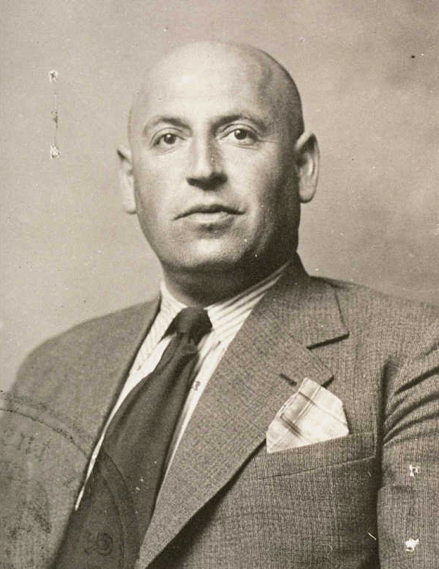
Er volgde een proces in Den Haag, met Cahn als hoofdverdachte. Acht personen stonden terecht, van wie er minstens vijf Joods waren. De aanklacht tegen Cahn luidde dat hij een Joodse terreurgroep had opgezet, die gebruikmaakte van gifgas en vuurwapens. Zijn mede-eigenaar Alfred Kohn, geboren in 1890, had hem daarbij geholpen.

Elias Rodrigues Garcia had de leiding van de knokploeg gehad. Garcia, een kleermakersgezel, geboren in 1909 in Amsterdam, had zijn jongere broer Simon en Abraham Muller ingeschakeld. Simon was een diamantbewerker. Muller werkte als privédetective. Cahn werd ter dood veroordeeld en op 3 maart 1941 gefusilleerd – de eerste man in bezet Nederland die voor een Duits vuurpeloton stierf. De andere Joodse aangeklaagden kregen gevangenis- en tuchthuisstraffen. Elias Rodrigues Garcia overleefde de bezetting. Zijn broer Simon werd in 1942 in Buchenwald vermoord, Muller en Kohn in 1944 en 1945 in Auschwitz.

Razzia

Al voor dat proces in Den Haag hadden de bezetters in Amsterdam een Joodse Raad gevormd. Die moest de Joden oproepen om hun wapens onmiddellijk in te leveren. De Duitse politie rapporteerde dat er aan deze oproep geen gevolg was gegeven. De bezetters stelden een ultimatum. Dat verliep op zaterdag 22 februari 1941. Op die dag en op zondag 23 februari namen de bezetters meer dan driehonderd Joodse mannen gevangen. De gevangenen waren tussen 20 en 35 jaar oud. Ze werden op gewelddadige wijze van straat geplukt en mishandeld. De bezetters voegden gearresteerde knokkers en Joodse mannen uit andere plaatsen toe, waardoor het totaal aantal gevangenen op 389 kwam. De hele groep ging op transport naar kampen als Buchenwald en Mauthausen. 

De Duitse actie op 22 en 23 februari 1941 was de eerste razzia in Nederland. De bevolking protesteerde op dinsdag 25 februari met een algemene staking tegen de Jodenvervolging. Die begon in Amsterdam, verspreidde zich naar andere steden en duurde twee dagen. De bezetters legden de verantwoordelijkheid voor de staking bij de Joden. Ze ontboden de door hen benoemde voorzitters van de Joodse Raad en dreigden met het doodschieten van vijfhonderd Joden als er geen einde kwam aan de staking. Toen ze later vreesden voor een herhaling van de staking, uitten ze nieuwe dreigementen.

Communisten

De bezetters zochten de organisatoren van de staking onder communisten, vooral Joodse communisten. Tijdens en na de staking arresteerden ze dan ook een aantal communisten. Drie van hen werden op 13 maart 1941 gefusilleerd. Een andere arrestant was Leendert Schijveschuurder. Ze pakten hem op 5 maart op. Schijveschuurder was in 1917 in Amsterdam in een groot gezin geboren. Hij was getrouwd en had een zoon. Zijn beroep was perser.

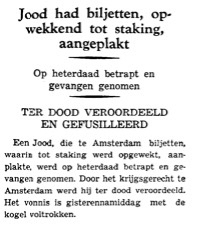
De Volkskrant 7 maart 1941.

Via het ANP verspreidden de Duitse politie het volgende bericht:

Vonnis voltrokken. ‘s Gravenhage, 6 maart – Een Jood, die te Amsterdam biljetten, waarin tot staking werd opgewekt, aanplakte, werd op heeterdaad betrapt en gevangen genomen. Door het Krijgsgerecht in Amsterdam werd hij ter dood veroordeeld. Het vonnis is hedenmiddag voltrokken. 

Schijveschuurder was de eerste Nederlander die voor een Duits vuurpeloton stierf. Zijn vrouw werd in 1943 in Sobibor vermoord. Hun zoon overleefde de bezetting. 

Tweeëntwintig andere communisten stonden terecht voor hoogverraad, dat wil zeggen voor hun aandeel in de staking en hun rol in de communistische organisatie. Onder de aangeklaagden waren twee wat de nazi’s noemden “Voljuden” (iemand met vier Joodse grootouders). Dat waren Rosa Boekdrukker-Hirsch en Joop van Weezel. 

Rosa Boekdrukker-Hirsch.

Volgens de akte van beschuldiging was Rosa Boekdrukker-Hirsch geboren in 1908 in Ostrowo, Polen. Haar vader was bakker. In 1921 verhuisde het gezin naar Berlijn. Daar ging Rosa naar de middelbare school en volgde een opleiding voor kinderverzorgster en kleuterleidster. In 1933 emigreerde ze naar Palestina, waar zij haar echtgenoot leerde kennen. In 1937 kwam het echtpaar naar Nederland. Een jaar later werd Rosa lid van de communistische partij. Het echtpaar scheidde. Zij verdiende de kost als schoonmaakster.

Leidinggevend

Boekdrukker-Hirsch was blijkbaar een belangrijke figuur in de illegale partijorganisatie. Volgens dezelfde akte van beschuldiging behoorde ze tot “de kleine kring van leidinggevende functionarissen, die in directe verbinding met de leider van het district stond”. In haar woning vonden illegale bijeenkomsten plaats en ze onderhield het contact tussen de Amsterdamse en de landelijke leiding. Na haar arrestatie weigerde ze tijdens de verhoren hardnekkig een verklaring af te leggen. Boekdrukker-Hirsch zat na arrestatie opgesloten in de gevangenis in Scheveningen. 

Het proces van de 22 communisten diende voor een civiele rechtbank, wat een rol speelde bij het bepalen van de strafmaat. Hierdoor waren de straffen relatief licht in vergelijking met de doodstraf die Leendert Schijveschuurder had gekregen. Rosa Boekdrukker-Hirsch kreeg de zwaarste staf: tien jaar tuchthuis. 

Boekdrukker-Hirsch zat eerst in het vrouwentuchthuis Anrath. In 1944 werd ze overgebracht naar Düsseldorf en vervolgens naar Ziegenhain. Daar werkte ze in een fabriek. In maart 1945 werd ze op transport gesteld naar Bergen-Belsen en daarna volgde het tuchthuis Fuhlsbüttel. Zij overleefde de bezetting. Ze trouwde voor een tweede keer in Israël en kreeg een zoon. Vlak na de bevrijding, in een pas later teruggevonden brief, schreef ze: 

Ik stelde al mijn kracht in dienst van de Communistische Partij omdat ik iets aan de verbetering van de maatschappij wilde doen. Toen de Duitsers het kleine Nederland overvielen, leeg plunderden en het volk alle vrijheid ontnamen, vonden zij hier in Amsterdam de grootste tegenstand. In februari 1941 begonnen zij met de jodenvervolging […] Onze partij had [de] staking voorbereid en werd daar ook verantwoordelijk voor gehouden.

Joop van Weezel.

De tweede “Voljude”, Joop van Weezel, was in 1909 in Amsterdam geboren in een sociaaldemocratisch gezin. Hij studeerde chemie en werkte enige tijd voor Philips in Eindhoven. Na een periode in de socialistische jeugdbeweging stapte Van Weezel over naar de communistische partij, waar hij secretaris werd van een buurtafdeling en voor De Tribune schreef.

Ook hij weigerde na zijn arrestatie in 1941 om vragen te beantwoorden: “U bent mijn vijand en ik geef geen antwoord.” Een zus van Joop vertelde me lang na de oorlog:

Mijn broer deed geen mededelingen over zijn [illegale] activiteit. Hij kwam weleens bij mij thuis slapen. Hij had geen vaste adressen. Ik denk dat hij bezig was met de voorbereidingen van die staking. Niemand sprak daarover, later ook nog niet.

Weer later hoorde zijn zus dat Joop de stakingsoproep had gestencild. Hij kreeg vier jaar tuchthuisstraf. Via de gevangenis in Scheveningen kwam hij in Dachau, waar hij op 25 april 1945 overleed aan vlektyfus. 

Mauthausen

Lang daarvoor waren de meeste van de bij de vechtpartij op 11 februari 1941 en de razzia van 22 en 23 februari opgepakte Joodse jongens en mannen vermoord in Buchenwald en Mauthausen (Arnold Arian werd in 1942 in Auschwitz omgebracht). Sommige overlijdensberichten arriveerden al in de eerste helft van 1941 in Nederland.

In 1941 ontving de familie Zilverberg hun eerste overlijdensbericht. Het betrof een broer van Lard die bij een razzia was opgepakt. Ook kwam er een overlijdensbericht over broer Philip, die had meegevochten op het Waterlooplein, was vrijgelaten en opnieuw aangehouden. Hij werd in 1942 in Auschwitz vermoord. Twee andere broers werden in 1943 omgebracht en hun vader en moeder in 1944. Alleen hun dochter overleefde de bezetting. Lard was in 1941 naar Buchenwald gestuurd, werd vandaar naar Mauthausen overgebracht en op 5 februari 1942 vermoord.

Uitkomst

Was het offer van Lard tevergeefs? Was het verzet van zijn Joodse strijdmakkers tevergeefs? Immers, de bezetting zou nog meer dan vier jaar duren en de Jodenvervolging ging door.

Nee, het was niet tevergeefs. De gebeurtenissen van februari 1941 versnelden en droegen bij aan de ontwikkeling van het algemene verzet tegen de bezetters. En dus aan de nederlaag van Nazi-Duitsland. Joods verzet hielp ook duizenden Joden die zich konden onttrekken aan de deportatie, het redde met name veel kinderen. En zo verhinderde het dat Hitler en de zijnen hun doel met de Joden bereikten – de Nazi’s konden het Joodse volk niet vernietigen.

*

Front cover Omdat ik geen lam voor de wolven wil zijn.

Dit is de tekst van een lezing die ik gaf op 11 februari 2025 in het Verzetsmuseum in Amsterdam, ter gelegenheid van de presentatie van mijn boek Omdat ik geen lam voor de wolven wil zijn: Joods verzet in Nederland in de Tweede Wereldoorlog.

De activiteiten van mensen zoals Lard Zilverberg – het terugvechten – en Rosa Boekdrukker-Hirsch – het mede-organiseren van de Februaristaking – zijn slechts twee voorbeelden van Joods verzet in Nederland in de Tweede Wereldoorlog. Al de vormen van Joods verzet komen aan de orde in dit boek.

Meer informatie over dat boek kan je hier vinden.

Categories
Joods verzet in Nederland

Het aantal Joden in verzet

Henriëtte Pimentel met een baby in de crèche.

Hoe groot was dat Joodse verzet nou eigenlijk? Dat wordt mij vaak gevraagd. Het antwoord is dat we het niet echt weten. Het precieze aantal Joden die in verzet kwamen tijdens de Duitse bezetting van Nederland tussen mei 1940 en mei 1945 is onbekend.

Om een voorbeeld te geven. Joodse verzetsmensen onder leiding van Henriëtte Pimentel smokkelden in 1942 en 1943 kinderen uit de crèche aan de overkant van het deportatiecentrum in de voormalige Hollandsche Schouwburg aan de Plantage Middenlaan in Amsterdam. Honderden kinderen konden zo onderduiken bij pleegouders en ze overleefden de Holocaust. Maar we zijn onzeker over precieze aantallen, ook over hoeveel mensen bij dat smokkelwerk betrokken waren. 

Wel een idee

Sinds 1961 hebben we wel een idee over de totale omvang van Joods verzet in Nederland. In dat jaar publiceerde de historicus Jacques Presser twee stellingen, die hij in 1965 herhaalde in zijn boek Ondergang:

  1. Het verzet door Joden is van Duitse zijde evenzeer overschat als van niet-Joodse Nederlandse zijde onderschat. 
  2. Dit verzet van Joden heeft kwantitatief – natuurlijk relatief – het niet-Joodse overtroffen.

Presser baseerde zich op de Erelijst der Gevallenen, waarop dat jaar ruim zeventienduizend namen stonden van gesneuvelde militairen en omgekomen verzetsmensen in Nederland. Presser kon 165 van hen als Joods identificeren. Verder vond hij honderden namen van Joodse verzetsdeelnemers die niet op de Erelijst voorkwamen. Mede op basis daarvan meende hij dat er onder de Joden een hoger percentage verzetslieden was dan in de niet-Joodse bevolkingsgroep.

Berekening

Presser noemde geen exacte cijfers, maar aan de hand van zijn tweede stelling is wel de volgende berekening te maken.

De laatste vooroorlogse volkstelling, in 1931, stelde vast dat er een jaar eerder 111.917 Joden in Nederland waren. Zij vormden 1,41 procent van de totale bevolking van 7,83 miljoen. In 1941 stonden er volgens Duitse maatstaven 140.522 Joden geregistreerd (dat wil zeggen 1,56 procent van de totale bevolking, die inmiddels was gegroeid tot 8,92 miljoen). 

Volgens de historicus Loe de Jong, in zijn werk Het Koninkrijk der Nederlanden in de Tweede Wereldoorlog, waren er in Nederland tijdens de gehele bezetting ongeveer 45.000 wat hij noemt ‘illegale werkers’ (georganiseerde verzetsmensen), wat overeenkomt met een half procent van de totale bevolking.

In het onderzoek voor mijn boek Zelfs als wij zullen verliezen van 1990 vond ik iets meer dan duizend namen van Joodse illegale werkers in Nederland. Dat is ruim twee derde procent van de Joodse bevolkingsgroep tijdens de registratie in 1941 en meer dan twee procent van de illegale werkers geteld door De Jong. Hieruit volgt dat de tweede stelling van Presser klopt.

Schatting

Het duizendtal Joodse illegale werkers dat ik in 1990 kon noemen, was overigens een lage schatting. Sindsdien is er veel onderzoek gedaan. Dat heeft tot dan toe nog ongenoemde Joodse verzetsmensen belicht. Er waren er dus meer. Misschien ligt het aantal Joden in verzet en illegaliteit in Nederland in de periode 1940-1945 daarom tussen 1500 en 2500. Het is op dit moment echter nog onmogelijk om een precies cijfer te geven.

Lyia Landau (derde van rechts) met ouders en vrienden.

Evenmin kunnen we iedere Joodse verzetsstrijder noemen. In het hierboven gebruikte voorbeeld van mensen die kinderen uit de crèche smokkelden, kenden we al langer enkele namen. Maar door nieuw onderzoek, bijvoorbeeld van Esther Shaya, Frank Hemminga en Tjitte de Vries, weten we nu meer over de beslissende rol van de directrice van de crèche, Henriëtte Pimentel, bij het smokkelen, en er zijn nieuwe namen opgedoken.

We vermoeden dat ongeveer een dozijn kinderverzorgsters het werk uitvoerden, op tal van ingenieuze manieren. In dat dozijn zat de 16-jarige verzorgster Lyia Landau. Bij zo’n smokkelpoging liep Lyia met een armband van de Joodse Raad van de crèche naar de Schouwburg aan de overkant van de Plantage Middenlaan. Ze deden dat geregeld om met de ouders van een kind te overleggen. In de Schouwburg gaf Lyia haar armband echter aan een meisje dat op haar leek. Dat stak vervolgens de laan over naar de crèche en verdween vandaar naar een onderduikadres. Lyia wachtte in een kleedkamer van de Schouwburg totdat een medewerkster van de crèche kwam, met haar armband in de zak, zodat Lyia weer op straat kon.

Tenslotte, is het erg dat het precieze aantal niet bekend is? Ik meen van niet. Cijfers zijn belangrijk. Maar om meer kennis te verwerven over het leven tijdens de bezetting en Joods verzet beter te begrijpen, kunnen we ook kijken naar groeps- en persoonlijke omstandigheden en karakteristieken van Joodse verzetsmensen. En dat doe ik in mijn nieuwe boek – Omdat ik geen lam voor de wolven wil zijn: Joods verzet in Nederland in de Tweede Wereldoorlog.

Front cover Omdat ik geen lam voor de wolven wil zijn.

Categories
Joods verzet in Nederland

Veelvormig verzet

George Maduro voor mei 1940 in militaire dienst bij de cavalerie.

George Maduro vond de dood in een concentratiekamp. Hij was nog geen 29 jaar oud. De laatste vijf jaar van zijn leven vocht George tegen de Duitsers. Die strijd begon direct in mei 1940 toen de Duitse strijdkrachten Nederland binnenvielen. Daarna ging hij in het verzet tegen de bezetters. Tot hij moest vluchten, opnieuw werd gepakt, voor de derde keer in de gevangenis belandde en in het kamp omkwam.

George geeft een gezicht aan Joods verzet – een onderwerp dat vaak over het hoofd wordt gezien. Je hoort nog wel eens het hardnekkige misverstand dat Joden in Nederland zich niet zouden hebben verzet tegen de Holocaust, die plaatsvond tijdens de Duitse bezetting. De werkelijkheid was anders.

Tal van manieren

Joden in Nederland reageerden op tal van manieren op de vervolging. Ze getuigden van hun geloof of cultuur. Ze lieten zich niet terroriseren. Ze vochten terug. Ze protesteerden. Ze schreven voor en maakten en illegale bladen. En hielpen die te verspreiden, vaak met groot gevaar voor hun eigen veiligheid. Ze onttrokken zich aan deportatie. Bijna dertigduizend Joden doken onder – een op de vijf Joden in Nederland – ondanks de Duitse overmacht, het negeren of zelfs steunen van de deportatie door leiders van Nederlandse overheidsinstanties en andere organisaties, en ondanks collaboratie, verraad en ontoereikende hulp van niet-Joodse landgenoten.

Netwerken om elkaar te helpen

Joden vormden netwerken om elkaar te assisteren in de onderduik. Ze hielpen opgepakte Joden ontsnappen uit deportatiecentra, treinen en doorgangskampen. Ze probeerden de deportatie te ontregelen met brandbommen en aanslagen. Ze stonden elkaar bij in pogingen om te overleven in vernietigings- en slavenarbeidskampen. En ze kwamen daar in opstand.

Joden vormden of sloten zich ook aan bij algemene, dat wil zeggen, niet-specifiek Joodse of gemengde verzetsgroepen. Een relatief groot aantal Joden deed dat in vergelijking met niet-Joden. Joden waren eveneens voortrekkers van gewapend verzet.

Lien Kuyper, waarschijnlijk voor mei 1940.

Een van hen was de kapster Lien Kuyper uit Rotterdam. Zij sloot zich aan bij de Landelijke Organisatie voor Hulp aan Onderduikers (LO). Lien was in 1942 ondergedoken. Eerst zwierf ze van schuilplaats naar schuilplaats. Tot de leider van de LO haar in februari 1943 in Amsterdam-Zuid ophaalde en naar zijn boerderij in Drenthe bracht. Hij stelde Lien aan als zijn persoonlijke koerierster. Zij was ook betrokken bij gewapende aanslagen. Dochters van de LO-leider beschreven Lien na de bezetting als een kordate en aantrekkelijke vrouw, vrolijk, soms heel geestig en ook erg moedig.

Weigerde te vluchten

Lien bleekte haar zwarte haar tot een rossige kleur. Ze kreeg een vals persoonsbewijs, maar op 17 juli 1943 werd Lien in Ugchelen gearresteerd. De politie bracht haar naar Westerbork, een doorgangskamp voor transporten van Joden naar Oost-Europa. De LO wilde een poging doen om Lien uit Westerbork te bevrijden. Zij weigerde echter te vluchten omdat voor iedere ontsnapte gevangene de nazi’s een aantal medegevangenen op straftransport stelden. Lien schreef op een briefkaart van 14 augustus 1943: ‘We komen er wel doorheen hoor.’ En op 24 augustus: ‘Op dit ogenblik zit ik in de trein en gaan we onze grote reis maken. Ik ben vol goede moed.’ Drie dagen later kwam Lien aan in Auschwitz, waar ze werd vermoord.

Al de vormen van Joods verzet komen aan de orde in mijn nieuwe boek – Omdat ik geen lam voor de wolven wil zijn: Joods verzet in Nederland in de Tweede Wereldoorlog.

Front cover Omdat ik geen lam voor de wolven wil zijn.
Categories
Jewish resistance to the Holocaust

A Museum view

The New York Times has asked my opinion about the controversy in the Netherlands over the new permanent exhibition of the Resistance Museum in Amsterdam. Here’s my view.

The Resistance Museum

For me, two of the main tasks of the science of history are to increase our knowledge of the past and deepen our understanding of what happened. For knowledge we require facts. And for understanding we need to view historical actors in their own perspective – they had to react to developments without knowing where these developments would lead and without knowing what the end-results of their actions would be. Unlike us, they didn’t benefit from hindsight.

Collecting, preserving and presenting heritage, a historical museum also has to engage the public and educate people. It has to bring the past to life with limited resources, such as space and time. By concentrating on the Second World War, the Resistance Museum faces an additional challenge. There was no such thing as ‘the resistance’ in the Netherlands during the years of German occupation between May 1940 and May 1945 – not one united movement, a single membership organisation or a common strategy. Instead, many different individuals, groups and networks conducted many different forms of resistance. And not all of this can be presented in a single exhibition.

My first impression is that the new permanent exhibition – with its chronology, use of film and personal stories – achieves these aims. There’s attention for Jewish resistance, which has previously been somewhat overlooked. The space devoted to different people, including National Socialists, which has been criticised in some media columns, doesn’t strike me as unbalanced. But it’s early days; only time will tell whether the Museum succeeds in the long run.

Controversy

Some of the publicity around the opening of the Museum has caused controversy. For example, about the using the word hero. ‘Hero’ or ‘heroine’ is a very subjective term, which has different meanings to different people. Its use suggests a value judgement being made, for example, expressing admiration.

During the 1980s I interviewed former resistance members, most of whom had so far never spoken publicly about their wartime activity. None of them wanted to be seen as heroic. They said they just did during the war what they felt that had to be done.

Furthermore, why denote people as ‘heroes’ when they took up arms, shot National Socialists and thus made a name for themselves, while overlook parents with children who couldn’t find a hiding place for their family, decided to let themselves be deported in the hope that they could continue to care for their children, and thus remained anonymous? Were they less courageous?

That’s why, like the Museum, in my work on Jewish resistance I’ve tried to avoid terms like ‘hero’ and ‘courage’, because the historian’s task isn’t to judge from a present-day perspective, which often distorts our view of the past. Instead, I’ve looked at group characteristics and personal circumstances that are measurable. Thus, I’ve found that Jewish resisters, for example people who saved Jews from deportation and cared for Jews in hiding, came from different population segments, differed in social position, age and gender, and ranged from individuals who were ideologically motivated to persons who simply wanted to help other Jews. Because they all fought against the odds, had a formidable enemy and constantly faced betrayal and arrest, resisters required a relentless energy as well as the ability to think quickly and act swiftly. They also had to be prepared to pay a heavy price – many of them lost their life.

Not new

Actually, controversy about wartime resistance isn’t new. Some resistance activity, such as the killing of traitors and collaborators, was already controversial during the war.

After the liberation of the Netherlands in May 1945, what the Dutch still call ‘de oorlog’ (‘the war’) has remained a sensitive subject. For a long time a ‘goed of fout’ (‘right or wrong’) view has dominated various public and political debates about contemporary issues. This view was purposefully related to the period of occupation with a perception of there being a simple wartime choice between resistance that was right and collaboration that was wrong, pertaining that in modern matters a simple choice is still appropriate. That perception is factually incorrect. In reality, during the war, the choice whether or not to conduct resistance, if at all possible, was much more complex for the vast majority of the Dutch population.

Why has controversy flared up again? At present, as before, people try to make sense of who they are, what to do, the reasons for doing it and how to do it. They search the past for examples in the shape of persons and acts they can emulate. Wartime resistance members and their activity can provide these examples. They are easily labelled as ‘heroes’ and their acts are called ‘courageous’. That’s fine, because searching and labelling is what humans do. But idolising resistance members now says something about the present; it doesn’t explain the past. 

Categories
Jewish resistance to the Holocaust

Boxer in Auschwitz

The starting point of my research into Jewish resistance to the Holocaust was a series of interviews I conducted in the 1980s with surviving members of that resistance. They told me some remarkable stories, including the account of Dutch Jews who boxed in concentration camps.

‘The SS guy at the gate recognised me. “Pity you’re Jewish,” he said. He knew me as a boxer and I had to fight a match. Against a Polish officer, one of the last. Well, they didn’t force me, but I was told it would be better if I boxed. A friend of mine, another inmate, also said I should do it. So they could come and watch. He never got a chance; only SS guards were allowed to watch.’

Scars

Leen Sanders finds it difficult to tell his story. When I interview him many years after the Second World War, he still resembles the Dutch boxing champion he once was, fighting in the feather to middle weight categories, when he proudly wore the Star of David on his shorts. His formerly athletic and muscled body wears the scars of numerous fights – the thickened ears and a broken nose.

Well hidden under his shirt sleeve, he has another scar – the tattooed number of a prisoner of Auschwitz. As we talk, memories return of his wife, his two young sons, his family and his friends, who all peristed in the Holocaust. He starts crying silently, unable to continue. The former fighter is brought down by mental images of scenes that no human can describe.

Boxing was a popular sport in the poor Jewish quarters of prewar Dutch cities. Training and matches offered an escape from the daily routine. It also built self-esteem as the art of self-defence required courage, stamina, quick reactions and technical skills such as fist- and footwork. 

Hard

Boys like Leen Sanders entered the ring at an early age, in fights where the Queensbury rules were disregarded. Hard fighting continued until one boxer stayed down to satisfy the gamblers. Those who passed these early stages and kept their appetite for the game, joined clubs that occasionally produced fine skilled boxers.

From these ranks young men joined resistance groups after the Nazis occupied their country in 1940. They showed determination. ‘Do you think I would allow these Nazis to get me?’ asks another interviewee, Bennie Bluhm from Amsterdam. ‘No. When you’re a boxer, you think you’re stronger and faster. You’re self-conscious. We were young and in the strength of our lives.’

In February 1941, these men were able to prove their courage. Dutch Nazis started to terrorise the inhabitants of the Jewish quarter in Amsterdam. But the Nazis ran into defiance from Jews who were prepared to put up a fight. During the ensuing street battles the Jewish fighters managed to defeat the Dutch Nazis, but the German SS broke their resistance. Several of Bennie Bluhm’s friends were arrested. One of them was  Lard Zilverberg, a national fly-weight boxing champion who had organised Jewish fighting groups. Bennie saw a photo of his arrested friend, but never saw Lard alive again.

One of Bennie’s friends who initially escaped was Ben Bril.

Gold

Ben had been born in Amsterdam. As a young boy he fought on the streets, occasionally against the boys of the next neighbourhood. But when Ben joined a boxing school he learned to control himself and avoid street brawls. He was also taught discipline. Ben worked in a butcher’s shop, where he solely used his left hand, being right-handed, to chop meat and bones in order to strengthen his left jab. He distinguished himself in the fly-weight category at the 1928 Olympic Games, at the age of 16, and reigned for almost a decade as boxing champion of The Netherlands. In 1935 Ben won a gold medal at the Maccabiade in Palestine. He also started to wear a Star of David on his boxing shorts.

Ben and his family went into hiding after the deporation of Jews from the Netherlands started in 1942. In 1943, however, the family was betrayed and transported.

In a transit camp Ben was quickly labelled ‘The Boxer’. After the war a fellow inmate testified that Ben was ‘the only man I saw during 2.5 years in concentration camps or heard about, who risked refusing to carry out a formal order of the SS, yes, without any hesitation to refuse.’

Whip

When I interview him, Ben remembers: ‘They knew I was a boxer. At one point there was a roll-call. A boy had attempted to escape. In women’s clothing. He had been caught. The boy was placed in front of a rack and was to get 25 whiplashes. Suddenly, the under-commandant called: “Boxer austreten!”. I had to come forward to carry out the punishment. I refused. The commandant said: “If you don’t do it, you’ll get 50.” So I took the whip, but when I had to strike, I aimed too high. The commandant got mad. “Not so,” he cried, grabbed the whip and started beating like mad. I walked back to my line.’

Ben organised boxing training and matches to get some extra food for the boys. 

Meanwhile, Leen Sanders had been active in the resistance against the German occupiers of the Netherlands. He and his family went in hiding after the deportation of the Jews from the Netherlands started. However, they too were betrayed and sent to Auschwitz, where Leen’s wife and sons were murdered on or shortly after arrival.

Help

Separated from his family, Leen used his boxing skills to survive and help others in Auschwitz. He explains: ‘It saved my life. I was given a job in the kitchen, providing I taught the boss how to box. I managed to get some extra bread, which I handed out among fellow inmates. I could save lives, because of the food. At my own risk. I had to hide it under my clothes. If you were causght, then, then … then they pushed you in the dirt; so far you’d never be able to get out. I was lucky.’

Again traumatic memories prevent Leen from continuing. After the war he received letters from people, thanking him for his help. He tried a come-back, but couldn’t box again. Just like many other Holocaust survivors, he was unable to return to normal life. Leen soon emigrated to the Dutch West Indies and from there to the United States. When I spoke to him, he had just returned to Rotterdam in Holland. An old man had come back to his birthplace to die.

—-

An earlier version of this article was published in the Glasgow Herald: ‘The Boxer of Auschwitz’.

The journalist Matthew Kenyon wrote an article about Ben Bril for the BBC Sport website: ‘The Dutch Jewish boxing champion sent to Nazi camps by Olympic team-mate’.

Categories
Jewish resistance to the Holocaust

Desperate but courageous

Eighty years ago the deportation of Jews from the Netherlands was well under way. After numerous measures had gradually segregated them from the rest of the population, Jews were ordered to wear a yellow star on their clothing. From July 1942 they received a summons for deportation. The advice was to pack suitable clothing and sturdy shoes, because they would be sent to a ‘labour camp in Eastern Europe’. An existing refugee camp in the east of the Netherlands, Westerbork, was turned into a transit camp. From there, the first transport to Auschwitz left mid-July 1942.

Jews had been involved in resistance from the start of the German occupation of the Netherlands in May 1940. The deportation increased that resistance and changed its character.

Rescuers

Not every Jew obeyed the deportation order. In total, almost 28,000 tried to evade deportation by going into hiding – one in every five Jews registered in the Netherlands in 1941. They refused to be terrorised by German threats and ignored the advice of the Jewish Council to obey (see The problems of hiding).

Many Jews in hiding were betrayed or discovered and deported, but more than half of them were saved by non-Jews and Jews, who operated individually or in small rescue and care groups that consisted mostly or entirely of Jews. Before July 1942 some of these groups had already looked after people in hiding, perhaps several hundred, but now that figure rose to thousands. The growing and constant demand for hiding places, falsified documents, news, food and other life essentials for people in hiding such as fuel caused an enormous extension of clandestine activity.

Find shelter

Student Judith Oostenbroek remembers that after she had helped her boyfriend to find a shelter in July 1942, she ‘was inundated with requests from others.’ So, she found more addresses where Jews could hide. And she often had to care for ‘her’ people in hiding. Not for a short while, but sometimes for over two and a half years.

Judith stopped studying (Social Work) and became a courier for several resistance groups, including the Oosteinde Group, which focussed on the care for people in hiding and the distribution of clandestine newspapers; it was named after the Amsterdam street where before the war a centre for Jewish refugees was located. Judith survived the war.

Children

Another group operated in one of the main deportation centres of the Dutch capital and managed to rescue hundreds of children. Walter Süskind had been appointed as a manager in the centre. He had fled Germany in 1938 and lived from 1942 in Amsterdam. This spirited organiser used his position, knowledge of German and subtle ways of handling German officials to develop an initiative to smuggling children out of the centre. He closely worked with Henriëtte Pimentel who was director of a nursery across the road, nurse Virginnie Cohen who succeeded Henriëtte as director, and other nursery staff.

Adult Jews awaiting deportation were unable to leave the centre, but babies, toddlers and young children were taken daily to the nursery. Walter and his co-workers asked the parents whether they wanted their child to be rescued. The question was asked because the rescued children would disappear and they wanted to prevent parents from panicking when their child was suddenly gone. Following parental approval, the registration documents of the children were removed from the centre’s administration. Then they took the children over a path through the back gardens of the two houses next to the nursery to a Protestant school, where members of general resistance groups collected the children and took them to foster parents. Sometimes children were transferred on the street when the nursery staff had permission to take them for a walk in the neighbourhood. In this manner, hundreds of children were extracted from deportation.

Walter and Henriëtte couldn’t or didn’t want to go into hiding. Walter and his family went on transport towards the end of the deportation and succumbed in camps and on death marches, which the Nazis started after their evacuation of the camps during the advance of the Soviet armies. Walter died aged 38. After deportation in 1943, Henriëtte was murdered in Auschwitz, aged 67. Virginnie survived the war.

Against the odds

Jewish resistance people couldn’t save everybody, often not even themselves or their families. They not only fought against the overwhelming German military might, but also against the preparedness of the top of the Dutch civil service and other organisations to ignore the persecution of Jews or even support it, and against widespread indifference and incidental collaboration amongst non-Jews.

Furthermore, non-Jewish resistance groups, which were able to look after large numbers in hiding, only developed during the final two years of the occupation. By then it was too late for the deported Jews: the last large transport from Westerbork left in September 1943.

Powerless

The powerlessness to stop the deportation turned Jewish resistance into a desperate, but courageous struggle.

Take, for example, Werner Stertzenbach, a Jewish refugee who was interned in Westerbork. He worded this despair when writing on 14 June 1942 to his girlfriend Stella Pach, a Dutch-Jewish course leader in vocational training in Amsterdam: ‘If you review the situation and possible outcomes, you may well come to the conclusion that we haven’t yet reached the nadir of our suffering.’ A few days later he added:

[…] I’m very downbeat […] I received a message from my parents, informing me that […] they have left on a transport to Poland. They write that what they’ve long feared is now happening […] It’s a tragic fate we all face […] Yes, we must realise that our life hasn’t yet reached its lowest point.

Werner was in touch with the Oosteinde Group. After the deportation of his parents, Werner helped more than 20 people escape from Westerbork and he was involved in another 20 successful escape attempts. For this purpose, he made use of the work he was forced to conduct on the sewage system of the camp. Part of the system was situated outside the barbed wire fence, where Werner was allowed to come. This way he could occasionally smuggle people out of the camp, mostly in a wheelbarrow or dump cart. These fugitives were awaited by warned members of the Oosteinde Group and taken to a hiding place.

In September 1943 Werner himself escaped form Westerbork, went into hiding and with Stella participated in the resistance work of the Oosteinde Group. They both survived the war.

Pioneers

Another German-Jewish refugee was Joachim Simon, who came to the Netherlands after the Kristallnacht in 1938. He was a member of the Palestine Pioneers, an international organisation of young Zionists who prepared for emigration to Palestine (see A pioneering group). Of the 820 Pioneers in the Netherlands in 1940, spread across different Pioneer centres, 393 survived the war, many with help from a group named after the non-Jewish teacher Joop Westerweel.

The Westerweel Group helped Pioneers in finding hiding places and supplied food ration cards and vouchers and false identity papers for more than 200 of them. They also set up escape routes to neutral Switzerland and Spain. About 150 Pioneers escaped from the Netherland with assistance from the Westerweel Group: 80 of them reached Spain, of whom 70 settled in Palestine.

Heated discussions

Joachim was one of the founders of this group, but his fellow Pioneers didn’t all agree with him about going into hiding. There were heated discussions – in the Pioneer centres and in letters – whether they had to hide and flee, as Joachim and other members of the Westerweel Group suggested, or whether they had to resign to the fate of deportation because of religious and cultural reasons. Should they face their destiny together with other Jews?

On 20 November 1942 Joachim wrote in a letter to a friend:

There’s so much to do. I do my uttermost to succeed, but who knows, maybe it’s too late and then I cannot do what’s necessary. Everything is so depressing, sometimes I don’t see an opportunity to persist. But you shouldn’t think too much. Even if everything seems almost hopeless, we may achieve something.

It’s still possible to fight against fate – even if we’ll lose, And if I have an accident tomorrow, I can have peace. I’ll not regret for one moment what we’ve done. We had the courage to fight and if we failed, that is our fate. And the thought that we haven’t fought only for ourselves gives us courage.

Joachim did indeed have an accident: he was arrested just across the Belgium border during one of his journeys for the group to establish an escape route. Imprisoned, he probably committed suicide on 27 January 1943, aged 23.

‘Arrow’

The sense of powerlessness was also expressed in clandestine publications such as Lichting. The April 1943 issue of this publication contained the poem ‘Arrow’:

A word of thanks for this view?
I know that it
Was aimed at an early death
And born from it.
The Arrow indicating where to sail
Also points at that.
Soon, we’ll all be submerged.

The author was Edgar Fossan, a penname of Leo Frijda (see Love and tragedy). He was studying as a medical analyst in a Jewish hospital in Amsterdam. Leo had joined CS-6, a not specifically Jewish group, which conducted espionage and sabotage. After the start of the deportation CS-6 got involved in rescue and care work, but it also took further action to prevent the deportation of Jews. The group tried to set fire to a collection centre in Amsterdam for Jews who were transported to Westerbork. They also attacked a train intended for deportation. Both attempts were unsuccessful.

Killings

As a result, Leo’s personality changed dramatically, as happened to many other resistance people: from a quiet boy he turned into a roaring caged animal, undertaking actions that would have been unthinkable for him earlier.

Early 1943 he was one of the CS-6 members who started to kill Dutch Nazis and collaborators, including Hendrik Seyffardt, head of the Dutch Legion of volunteers in the Waffen-SS, and Herman Reydon, Secretary General of a Dutch government department. Leo was closely involved in their shootings, exactly how we don’t know; but it’s certain he killed two other traitors. Shortly after these assaults he was arrested, tried, sentenced to death and executed on 1 October 1943, aged 20.

Controversy

The liquidation of collaborators and traitors was controversial, even in resistance circles, also because of the severe German reactions. As reprisals the Nazis randomly took hundreds of hostages and publicly executed them and other prisoners. Several resistance groups revenged these executions by killing more opponents. It created a spiral of lethal violence.

Other resistance organisations, including the Oosteinde and Westerweel groups, remained non-violent because of the reprisals or for principal or practical reasons, for example because they didn’t have access to firearms and explosives. Nevertheless, all Jews who individually or in small groups conducted resistance contributed to the Holocaust survival of thousands of Jews in Netherlands, among whom were many children.

*

A shorter Dutch version of this post was published in Geschiedenis Magazine (2022): ‘Joods verzet tijdens de Tweede Wereldoorlog: “Wij hadden de moed te vechten”.’

Categories
Jewish resistance to the Holocaust

How many were involved?

After the publication of my book Individuals and Small Groups in Jewish Resistance to the Holocaust – A Case Study of a Young Couple and Their Friends (2022) I have been asked several times: How much Jewish resistance was there; how many people were involved? The answer is that we don’t know exactly.

An example: Jewish resistance members smuggled children out of a nursery in an Amsterdam deportation centre and took them to hiding places, but we’re unsure about precise figures.

However, since 1961 we have an idea. In that year the historian Jacques Presser published his thesis, stating that Jewish resistance in the Netherlands was as much overestimated by the German occupiers of the country as it was underrated by the Dutch population and that resistance by Jews in the Netherlands had relatively exceeded resistance by non-Jews. He based his thesis on the Roll of Honour, a list of fallen soldiers and resistance members. Presser had identified a large number of names on this list as Jewish. He also found hundreds of names of Jewish resistance members in the documents he examined in the course of the research for his work Ondergang (1965), a figure which he compared to what was known at the time about numbers of general resistance members. Presser didn’t mention exact figures, but on the basis of his thesis the following calculation can be made.

Calculation

During the last pre-war census, which took place in 1930, over one hundred and eleven thousand Jews were in the Netherlands. They formed 1.41% of the total Dutch population of 7.83 million. In 1941 about one hundred and forty thousand Jews were registered in the Netherlands according to Nazi yardsticks (that represented 1.56% of the total population which had grown to 8.92 million).

According to the historian Loe de Jong, in his work Het Koninkrijk der Nederlanden in de Tweede Wereldoorlog (vol. VII, 1976), in total an estimated forty-five thousand illegal workers were active in the Netherlands during the entire period of German occupation between 1940 and 1945. This corresponds with a half percent of the total population. De Jong defined an illegal worker as somebody who was active clandestinely as an individual or member of organised collectives in their resistance to the German occupiers.

In 1990, I mentioned almost a thousand names of Jewish illegal workers in my book Zelfs als wij zullen verliezen. That’s more than two-thirds of a percentage of the Jewish population in the registration of 1941, which confirms the second part of Presser’s thesis.

A low estimate

The figure of a thousand illegal Jewish workers I mentioned in 1990 is a low estimate. Since then, more research has been conducted, which has brought to light the resistance activity of numerous, but until then unknown Jewish resistance members.

In the above example of the people who smuggled children out of the deportation nursery, we knew that Walter Süskind, Henriëtte Pimentel and Virginnie Cohen were involved, but recently more information has come to light about the role of the last two women and another child carer, namely Betty Oudkerk, who with others all helped to save perhaps hundreds of children.

However, it’s presently impossible to give an exact number of Jews involved in resistance. Does that matter? I don’t think so. Figures are important, but to gain a greater knowledge about Jewish life during the Holocaust and get a deeper understanding of Jewish resistance we can also look at personal circumstances and characteristics of Jewish resistance members and the formation of small Jewish resistance groups. And that’s what I’ve done in the 2022 case study.

*

My book, Individuals and Small Groups in Jewish Resistance to the Holocaust. A Case Study of a Young Couple and their Friends, is published by Anthem Press.